When Election Audits Become “Security Theater” What Philip Stark’s Georgia Analysis Reveals About Verifying American Elections
A Warning for Every State: What Georgia’s 2020 Audit Reveals About Election Verification: No, Recounts Don’t Prove Elections — Evidence Does

By John R. Brakey
Executive Director, AUDIT USA
Monday, March 9, 2026 1:38 PM
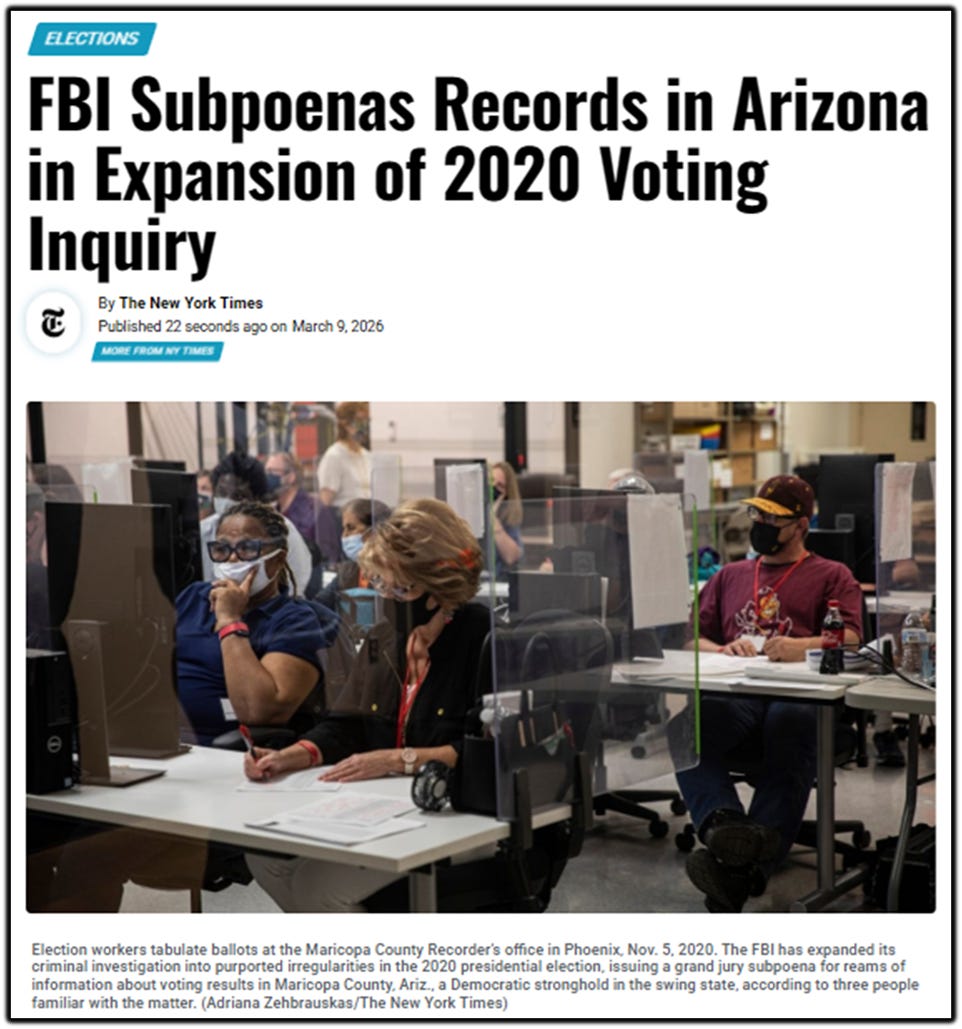
Breaking: In March 9th 2026, reports also emerged that federal investigators had issued a grand jury subpoena seeking election records from Maricopa County, Arizona—the largest county in the state. The request reportedly includes electronic voting data and materials related to the Arizona Senate’s 2020 audit. If confirmed, the move suggests that federal investigators may be examining election records in multiple states, not just Georgia.
Could Ballot Images Loosen the Grip of Disinformation?”
Steven Rosenfeld — April 4, 2023
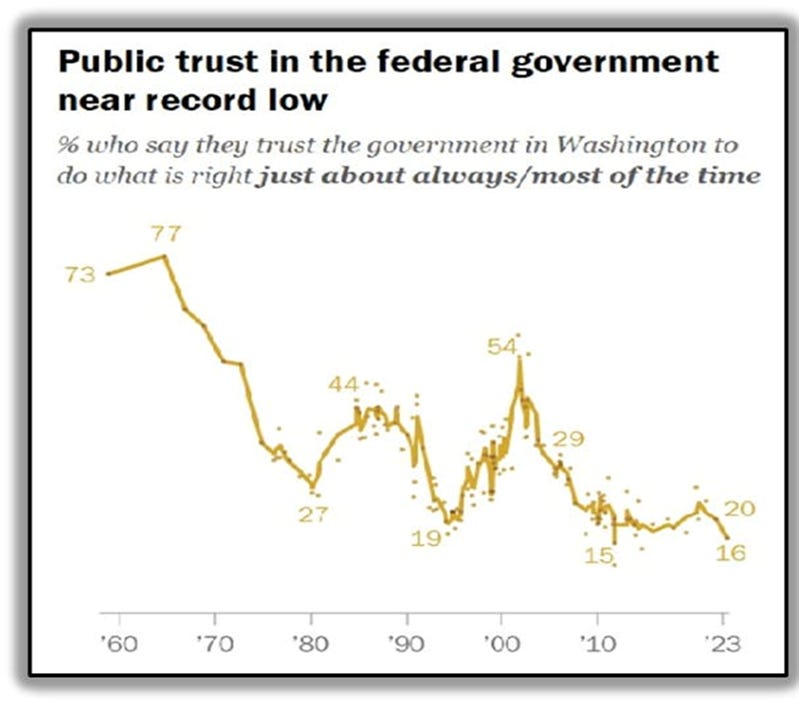
“This push toward radical transparency represents a sea change for U.S. election management. For most of the last century, officials have simply asked citizens to trust that a count is correct, that the systems in place were credible. That era is over, Fontes said. Public trust in government institutions is now at a near-historic low; just 20 percent of Americans say they’re very confident in the country’s elections, according to a January 2022 ABC/Ipsos poll. The modern American public needs more proof, Fontes said, and ballot images are the key. ‘The principle that a person can walk into a county treasurer’s office and ask for the budget and be shown where the money from the county is actually being spent is almost exactly the same,’ Fontes said. Except that this is actually better, because this is the real representation. It’s as if you walked into the county treasurer’s office and got copies of all of the canceled checks.’”
Executive Summary
When Election Audits Become “Security Theater”
This report examines the implications of research by Dr. Philip B. Stark, a leading election auditing expert and the creator of the risk-limiting audit, regarding the verification of the 2020 presidential election in Georgia.
Stark’s analysis does not claim that the election outcome was incorrect.
Instead, his research raises a deeper question: whether the election system produced records strong enough to verify the outcome with high confidence.
His conclusion was striking.
Even after a recount and a process described as a risk-limiting audit, Stark found that weak ballot accounting, incomplete records, and gaps in documentation made it difficult to demonstrate the accuracy of the reported outcome through evidence alone.
The lesson extends far beyond Georgia.
Across the United States, election debates increasingly revolve around trust, procedure, and political claims, rather than verifiable evidence.
Stark warns that when election records are incomplete or poorly documented, audits can become what he describes as “security theater” — processes that appear rigorous but cannot actually prove that results are correct.
This report explains the structural issues Stark identified, including:
• weak ballot accounting procedures
• gaps in chain-of-custody documentation
• incomplete audit records
• missing ballot images
• potential duplicate ballot scans
• reliance on ballot-marking devices that may not always produce a reliable record of voter intent
None of these issues necessarily proves wrongdoing.
But together they illustrate a critical principle:
Audits cannot compensate for weak records.
If the underlying evidence is incomplete or inconsistent, recounts and audits may reassure the public without actually proving the outcome.
However, the same digital voting systems that create these challenges also produce powerful verification records that are often underused.
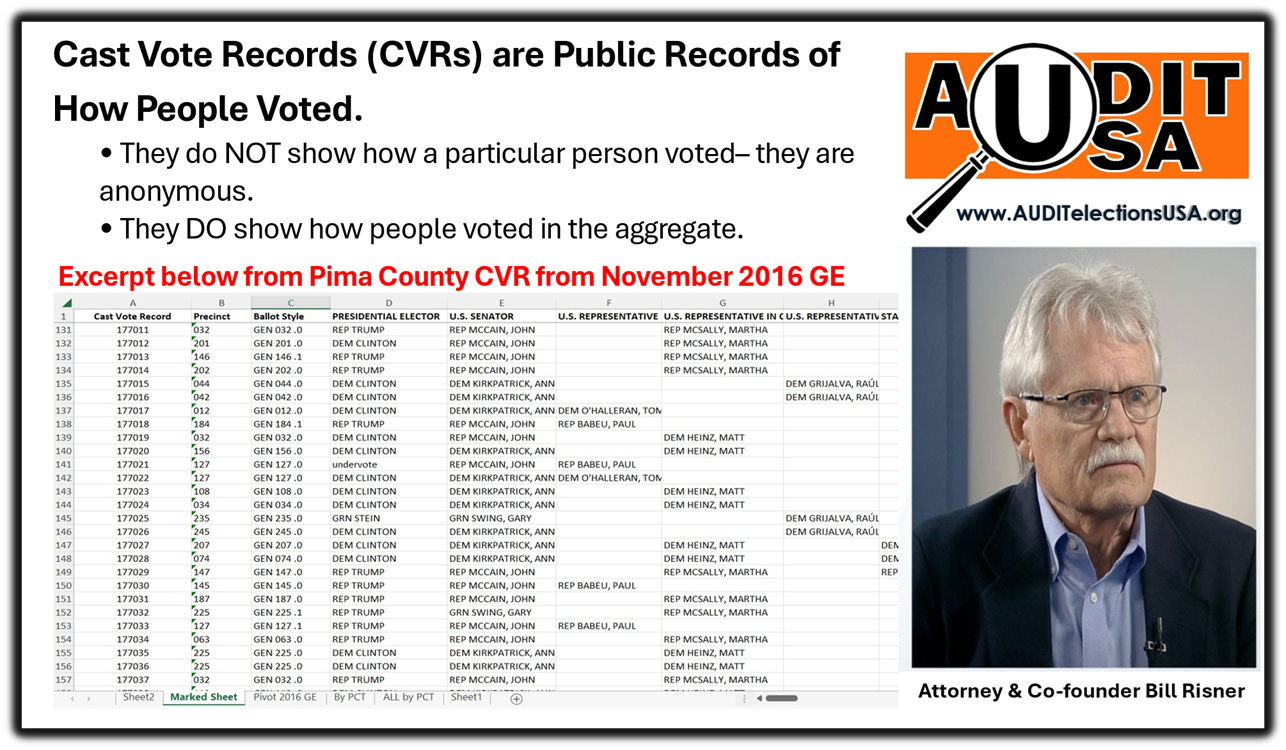
Modern election scanners typically generate two independent records for every ballot:
• ballot images — digital images of each scanned ballot
• cast vote records (CVRs) — the machine’s interpretation of each ballot
When these two records are compared and analyzed together, elections can be reconstructed and verified with far greater precision.
By organizing those records precinct by precinct, investigators can identify discrepancies quickly and trace them to their source. What would otherwise be a search through hundreds of thousands of ballots becomes a targeted investigation.
This report describes how tools such as Auditable Ballot Examination (ABE) can use ballot images and CVR data to reconstruct precinct-level results rapidly, allowing election officials and observers to confirm machine tabulation or identify potential errors.
Former Arizona Secretary of State Ken Bennett summarizes the core requirements of a verifiable election with five simple questions:
How many people voted?
Are those voters recorded in the participation list?
Do the number of ballots match the number of voters?
Do ballots match the machine tabulation?
Can observers verify a sample of the original ballots?
When election systems can answer these questions clearly and transparently, confidence comes not from trust alone but from evidence that can be independently examined.
The central lesson of Stark’s work is not that elections are broken.
It is that verifiable elections require strong records and transparent verification methods.
Modern voting systems already produce much of the evidence needed to verify election outcomes. The challenge now is to organize and analyze those records in ways that allow the public to see and confirm the results for themselves.
In a healthy democratic republic, election outcomes should not depend on political claims, partisan narratives, or procedural assurances.
They should depend on evidence. Evidence that can be examined. Evidence that can be challenged.
And evidence that ultimately confirms the will of the voters.
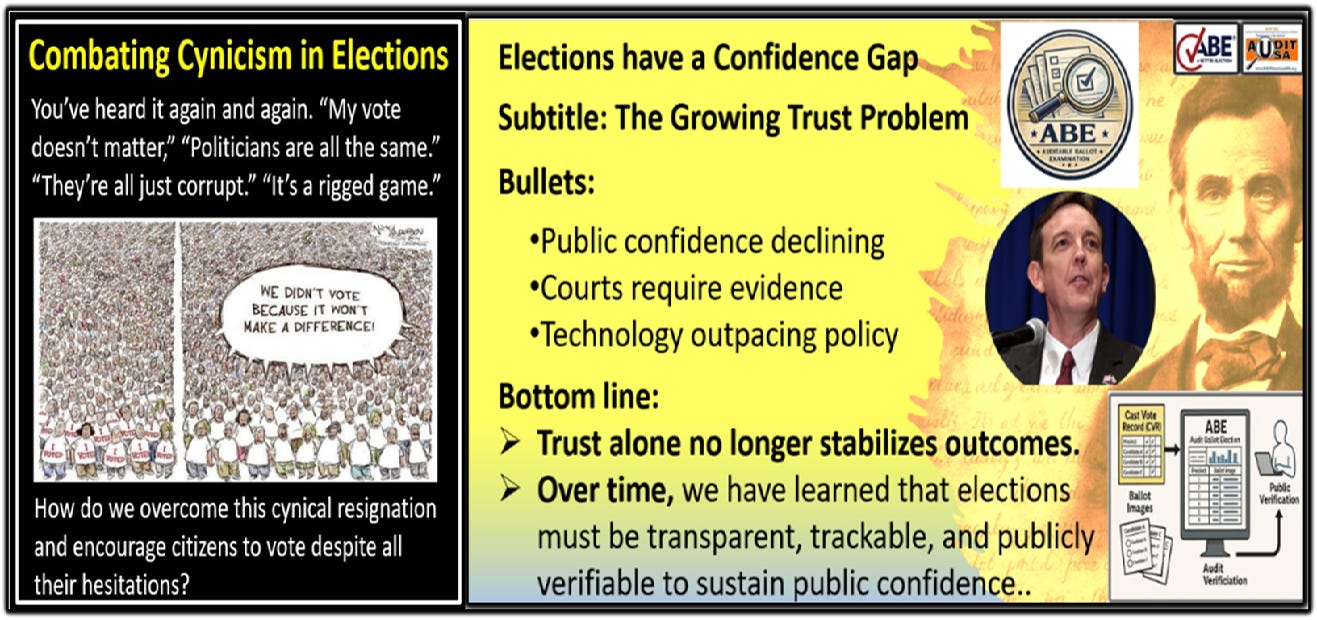
The Central Finding
“When it comes to elections, the main issue isn’t just about who wins; it’s whether the system creates records that can reliably prove the outcome with solid evidence.”
Such records exist and are accessible to the public—they rightfully belong to “we the people.”
John R. Brakey
Executive Director, AUDIT Elections USA
Co-Developer of the ABE Hybrid Verification System
Election Transparency Investigator, Educator & Reform Advocate 520-339-2696 JohnBrakey@gmail.com Link to this story on John Brakey Substack
Full Investigative Reports & Media Assets:
1. When Election Audits Become “Security Theater”
What Philip Stark’s Georgia Analysis Reveals About Verifying American Elections
2. PRESS RELEASE FOR IMMEDIATE RELEASE 3.5.2026
3. Open Letter to Pima County Board of Supervisors (3/3/2026)
4. APPENDIX A: To Board of Supervisors’ Role During the Canvass
5. AUDIT USA Special Public Accountability Report: On the $2.67 Billion Vote
6. The Timing Question: Why is there a $2.67 billion vote scheduled for March?
Table of Contents and link to this report as a PDF
I. The FBI Now Has Georgia’s 2020 Ballots
II. The Scientist Who Raised the Alarm
III. Three Things Every Reader Should Understand
IV. The Structural Weaknesses Stark Identified
V. Chain-of-Custody Gaps
VI. Evidence of Duplicate Ballot Scans
VII. A Deeper Structural Problem: Ballot-Marking Devices
VIII. Stark’s Bigger Lesson
IX. Watching Georgia from the Maricopa Audit in 2021
X. The Evidence Elections Already Produce
XI. From Optical Mark-Sense to Digital Scanning
XII. Are Ballot Images Anonymous?
XIII. When Elections Become Messy
XIV. The Shock to Georgia’s Election System
XV. Why Precincts Are the Building Blocks of Election
XVI. Speed and Accuracy
XVII. Cleaning Up the Mess
XVIII. Transition to Precinct Verification
XIX. Ken Bennett’s Five
XX. The Opportunity for Transparent Elections
XXI. Final Thought
I. The FBI Now Has Fulton County, Georgia’s 2020 Ballots
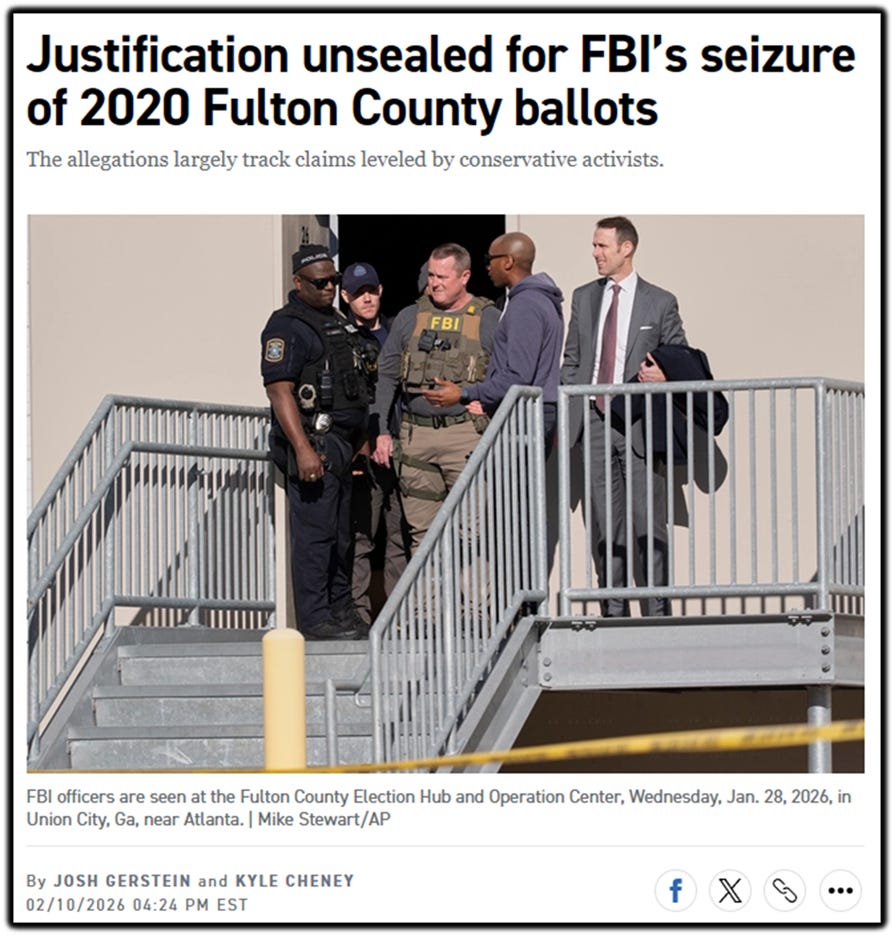
Four years after the 2020 election, the records at the center of one of America’s most polarizing political battles are back in the spotlight.
In early 2026, federal agents seized thousands of election records from Fulton County, Georgia, including ballots, ballot images, and voting-system data
Georgia election official says they do not know where FBI took 2020 ballots after raid The FBI raided a county election facility in Georgia on Wednesday, looking for ballots and other records from the 2020 election. CBS News’ Skyler Henry and Jessica Levinson have more. Jan 29, 2026
Some observers immediately claimed the seizure proves fraud.
Others insisted it proves nothing at all.
But long before federal agents arrived, a respected election scientist had already warned about a deeper issue.
The deeper issue was not simply whether fraud occurred, according to Dr. Philip B. Stark, a statistician at the University of California, Berkeley. The question was whether the election system produced records strong enough to verify the reported outcome with confidence.
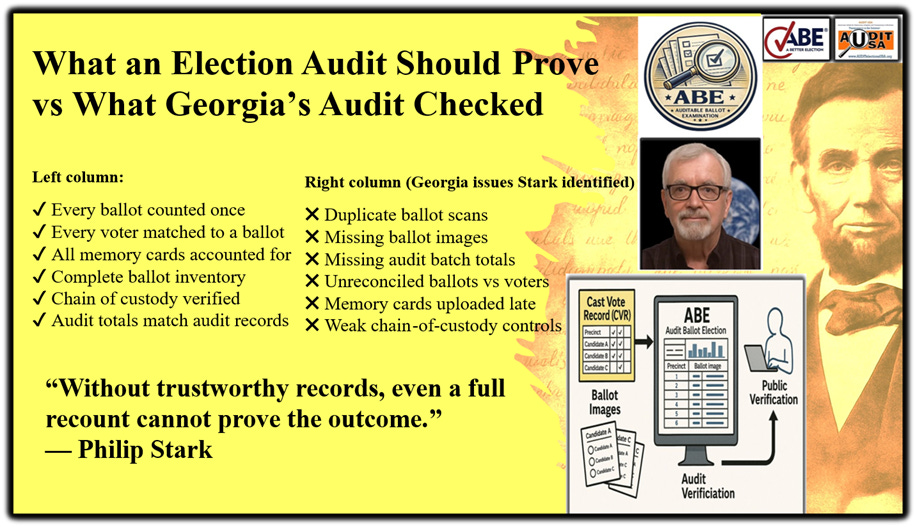
That is why Dr. Philip Stark’s work matters so much right now.
When Audits and Recounts Distract from Election Integrity:
The 2020 U.S. Presidential Election in Georgia
To appear in Proceedings of E-Vote-ID 2024, LNI - Philip B. Stark
II. The Scientist Who Raised the Alarm
In 2024, Dr. Stark published a detailed analysis of Georgia’s recount and audit process. https://par.nsf.gov/servlets/purl/10656284
Stark is not a political activist. He is one of the world’s leading authorities on election auditing and the creator of the risk-limiting audit, a statistical method now used in elections across the United States.
His conclusion about Georgia was striking. It was not partisan. It was structural.
Even after a recount and what officials described as a risk-limiting audit, Stark concluded that Georgia’s election system lacked the reliable records and controls needed to prove the reported outcome with high confidence.
Not because fraud had been proven.
But because the underlying ballot accounting, chain-of-custody procedures, and election records were too weak to provide reliable proof either way.
That lesson reaches far beyond Georgia. It applies to every election in America.
If an election system cannot produce the evidence needed to prove its outcome, public trust becomes vulnerable to politics, rumor, manipulation, and fear.
III. Three Things Every Reader Should Understand
Stark did not claim fraud.
His research does not assert that the election outcome was wrong. Instead, it concludes that Georgia’s recount and audit process lacked sufficiently reliable records and controls to prove the outcome with high confidence.Audits cannot compensate for weak records.
If ballot accounting, chain-of-custody documentation, or election records are unreliable, even sophisticated audits can become what Stark describes as “security theater.”Verification is still possible.
Modern voting systems already generate records—such as ballot images and cast vote records (CVRs)—that can be compared to confirm whether machines counted ballots correctly.
The broader lesson, as we interpret Stark’s analysis, is that verifiable elections depend on evidence that can be independently examined—not simply on procedural assurances.
IV. The Structural Weaknesses Stark Identified
Stark’s analysis highlighted several weaknesses in Georgia’s audit system.
These weaknesses do not automatically prove wrongdoing.
But they make it much harder to prove accuracy.
Weak Ballot Accounting
Georgia lacked reliable procedures confirming that:
every ballot cast was counted
every ballot was counted exactly once
the number of voters matched the number of ballots
These are among the most basic checks in any accountable election system.
If a jurisdiction cannot confidently answer those questions, then every later assurance rests on a weak foundation.
Ballot accounting is not some technical luxury.
It is the beginning of election integrity.
Video DEF CON 33 Voting Village - Risk Limiting Audits: What They Are and Aren’t - Philip Stark
“Risk-limiting audits (RLAs) limit the "risk" of certifying that the wrong candidates won. There are RLA methods for almost every type of political election in the US, including plurality, multiwinner plurality, supermajority, and instant-runoff voting. The latest RLA methods make it practical to audit every contest in every election, even in large jurisdictions with hundreds of contests. RLAs can "tie a bow around" a well-run election that uses trustworthy, organized methods to record and store votes. They cannot magically make a poorly run election trustworthy any more than fastening your seatbelt after an accident will prevent injury. Applying RLA procedures to an untrustworthy vote record is "security theater" that does not limit the risk of certifying the wrong winners.”
AUDIT USA: Why Precinct-Level Verification Matters
A trustworthy election system must verify that ballots are complete, properly tracked by precinct, and reconciled before claiming that its tabulation is accurate.
Precincts are the basic building blocks of election accountability.
When a discrepancy appears, the most effective way to locate the problem is not by looking at the overall countywide total, but by examining the results precinct by precinct.
For example, if 1,500 voters participated in a precinct, the system should confirm that 1,500 ballots were counted.
When the numbers do not reconcile, investigators immediately know where to begin looking.
Instead of combing through hundreds of thousands of ballots across an entire county, officials can focus on the specific precinct where the numbers do not balance.
This is one of the strengths of the Auditable Ballot Examination (ABE) method.
Once the official precinct results are produced by the election system, those results can be compared against the precinct totals generated through ABE’s independent analysis of ballot images and cast vote records.
If the numbers match, confidence increases.
If the numbers do not match, the system immediately identifies where further investigation is needed.
In many cases, discrepancies turn out to be ordinary administrative errors. For example, a batch of ballots may have been accidentally scanned twice during central tabulation. Because ballot batches are often processed in groups of around 200 ballots, and those batches can contain ballots from many different precincts, a single scanning error can affect multiple precinct totals.
That is precisely why precinct-level reconciliation is so important. By comparing results at the precinct level, investigators can quickly identify where the imbalance occurred and trace it back to the source.
In short, precinct verification allows election officials to move from guesswork to targeted investigation.
And with modern records such as ballot images and cast vote records, that verification can often be performed quickly, transparently, and independently.
ABE can analyze a county of roughly 375,000 voters with about 350 precincts and generate a complete CVR database in under five minutes. It can then produce 350 separate precinct-level CVR reports—each linked to the underlying ballot records—in under an hour.
V. Chain-of-Custody Gaps
The system also lacked strong documentation tracking:
• ballots
• memory cards
• election media
• voting system components
Without reliable chain-of-custody procedures, investigators cannot easily reconstruct events if discrepancies appear.
A well-run election should be able to show where ballots were, how they were stored, who handled them, and whether all related materials were accounted for.
If those records are weak, incomplete, or inconsistent, then confidence in the final result becomes a matter of trust rather than proof.
Missing Audit Data
One of Stark’s most striking findings involved Fulton County.
Audit batch sheets showed 1,927 tally sheets, but the audit spreadsheet contained only 1,916 entries.
That means at least 11 batches were missing from the reported totals—representing more than 3,900 votes that had been manually counted but not included in the audit spreadsheet.
Stark does not claim this discrepancy changed the outcome.
However, he argues that inconsistencies like this weaken the evidentiary strength of the audit itself. If the audit’s own records are incomplete or inconsistent, the audit cannot serve as strong proof of the reported outcome.
IV. Evidence of Duplicate Ballot Scans
Researchers involved in the Curling v. Raffensperger litigation also reported irregularities in ballot image records.
Analysts identified 2,871 sets of ballot images that appeared to have been scanned more than once, including:
duplicate ballot images
duplicated ballot-marking device cards
triplicate scans
Again, Stark does not claim that these findings prove the election outcome was incorrect.
However, such irregularities illustrate weaknesses in election recordkeeping that make verification more difficult.
If ballots or ballot images appear to have been counted more than once, the problem is not simply clerical. It raises evidentiary questions that must be resolved before the integrity of the result can be confidently verified.
Missing Ballot Images
Another major concern Stark raised was incomplete ballot image production.
For the first machine count in Fulton County there were:
528,776 cast vote records but only 168,726 ballot image files.
That left more than 376,000 ballot images missing from the available records.
Stark’s point is straightforward: without complete records, reconstructing what happened during the election becomes significantly more difficult.
When election officials state that an election was audited, but the underlying records are incomplete, the audit may provide reassurance without necessarily providing strong proof.
This is one of the situations Stark warns can produce “security theater”—procedures that appear rigorous but cannot fully verify the outcome.
VII. A Deeper Structural Problem: Ballot-Marking Devices
Stark’s analysis also raises concerns about Georgia’s reliance on ballot-marking devices (BMDs).
Georgia required most in-person voters to use Dominion BMDs, which print a paper summary of the voter’s selections.
Stark argues that these printouts may not always provide a trustworthy record of voter intent. Among the concerns he raises:
ballot-marking devices can be misconfigured, malfunction, or be vulnerable to tampering
many voters do not carefully verify the printed summary
post-election procedures cannot reliably determine whether the printed ballot accurately reflects the voter’s intent
As a result, Stark argues that even a perfectly conducted recount could still be recounting an unreliable record.
If the paper record itself does not reliably capture voter intent, then auditing that record cannot fully resolve the underlying uncertainty.
VIII. Stark’s Bigger Lesson
Recounts and audits are powerful tools.
But they are not magic.
They cannot compensate for:
weak ballot accounting
poor chain-of-custody procedures
incomplete election records
unreliable vote records
When those conditions exist, Stark warns that audits risk becoming “security theater.”
At AUDIT USA, we often use a closely related phrase: “election theater.”
Different words, but a similar concern.
Public confidence should not depend on ceremony alone—not simply on repeating the word “audit.”
In a democracy, confidence should come from evidence that can be examined, challenged, and confirmed.
IX. Watching Georgia from the Maricopa Audit in 2021
One important part of this story is where Ken Bennett and I were when the events in Georgia were unfolding.
In 2021, during the aftermath of the 2020 election, the Arizona Senate appointed former Arizona Secretary of State Ken Bennett to serve as the Senate’s liaison to the review of ballots in Maricopa County.
Ken asked me to assist him as a deputy and election systems advisor. I am a registered Democrat, and my role was to help evaluate the technical claims being made about the election systems and procedures.
Our small advisory group was intentionally bipartisan. Ken was a Republican. I was a Democrat. Another advisor was a Libertarian. The idea was simple: if election claims were going to be examined, they should be examined from multiple perspectives.
During that time, we closely followed what was happening in other states, including Georgia, where recounts and audits were also taking place.
What we observed reinforced an important lesson.
Many of the people raising concerns about the election were sincere. They believed they were defending democracy. But we also saw how easily complex election procedures could be misunderstood — and how quickly misinformation could spread through partisan media ecosystems and social networks.
In that environment, honest questions were often mixed together with exaggerated claims, misunderstandings, and, in some cases, efforts to exploit public distrust.
For Ken and me, the experience had an unexpected result.
Despite coming from different political parties, we found ourselves agreeing on something fundamental:
If Americans are going to trust elections again, the answer cannot be more rhetoric, more accusations, or more political theater.
The answer has to be evidence that the public can verify.
That realization is one of the reasons we have focused so much attention on systems that allow elections to be independently verified using the records elections already produce — such as ballot images and cast vote records.
In a democracy, confidence should not depend on which political party is speaking.
It should depend on whether the evidence can be examined by anyone.
X. The Evidence Elections Already Produce
Fortunately, modern voting systems already produce records that make transparent verification possible if hand-marked paper ballots are the primary voting method.
Two records are especially important.
1) Ballot Images
A ballot image is a digital image created when a paper ballot is scanned by a modern digital voting system.
The image captures exactly what the scanner saw when the ballot was tabulated. It shows the voter’s selections in each contest while preserving the anonymity of the voter.
Ballot images are not interpretations.
They are digital photographs of the ballot as scanned.
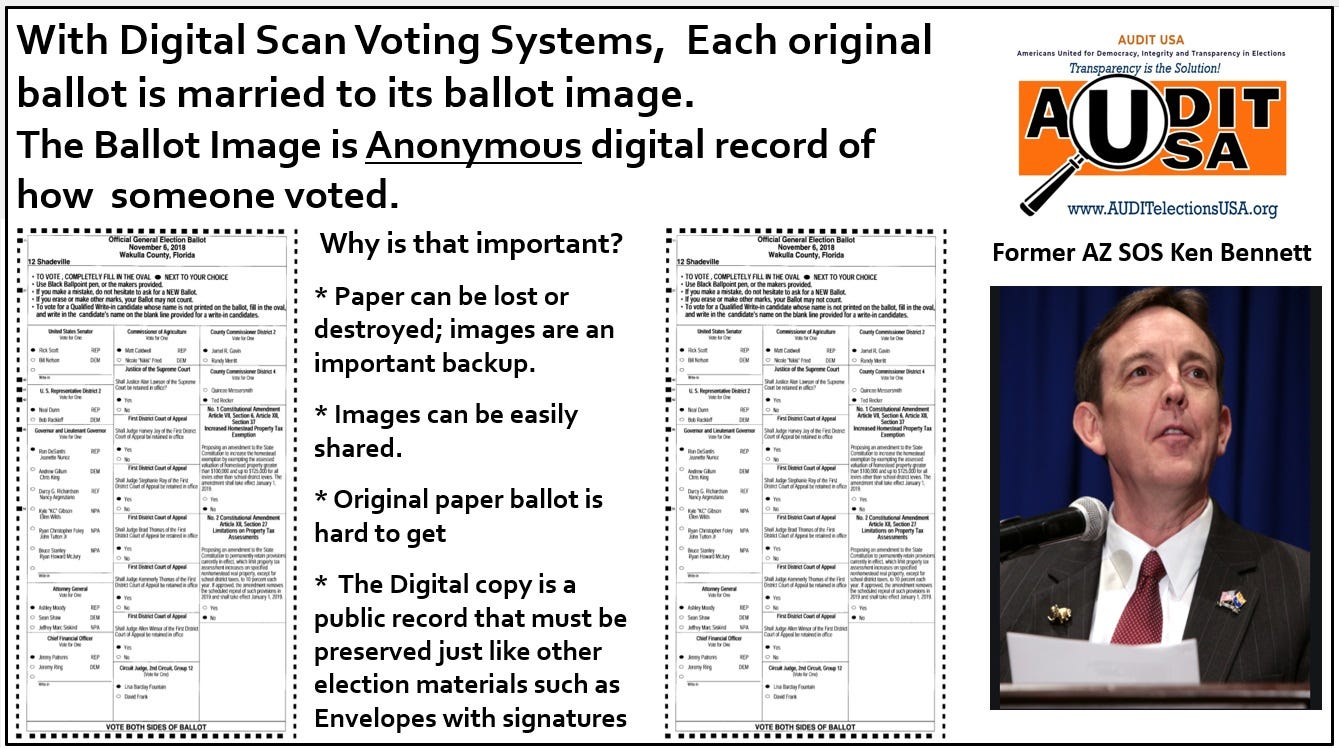
Because the image preserves what the scanner actually saw, it becomes a permanent visual record that can later be reviewed to confirm how the ballot was interpreted.
2) Cast Vote Records (CVRs)
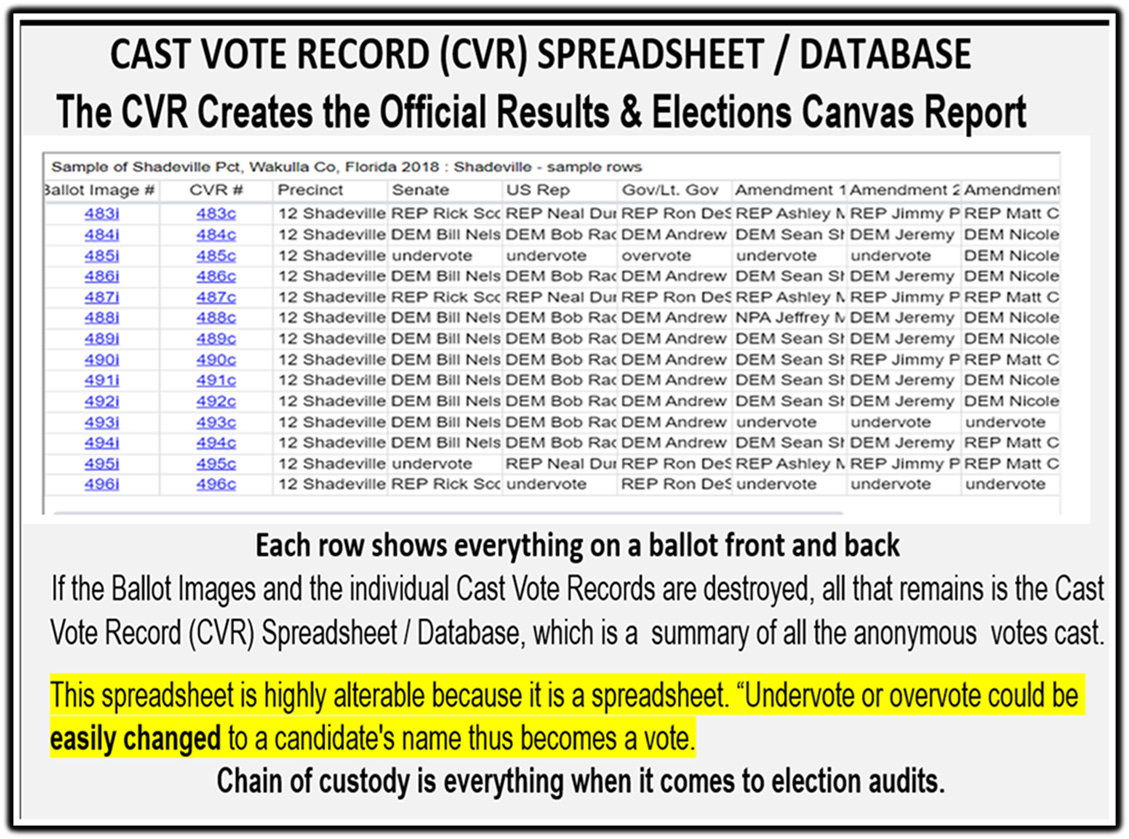
Is the voting system’s digital interpretation of an individual ballot.
When a paper ballot is scanned by a modern digital tabulator, the system first creates a ballot image—a digital picture of the ballot exactly as the scanner saw it. The software then reads that image and records the voter’s selections in a structured data format.
Each row in the CVR database represents one ballot, listing the choices the scanner recorded for each contest on that ballot.
In effect, the CVR is the dataset that tells the tabulation software how to count the votes. When election results are reported and certified, the totals come from this CVR database.
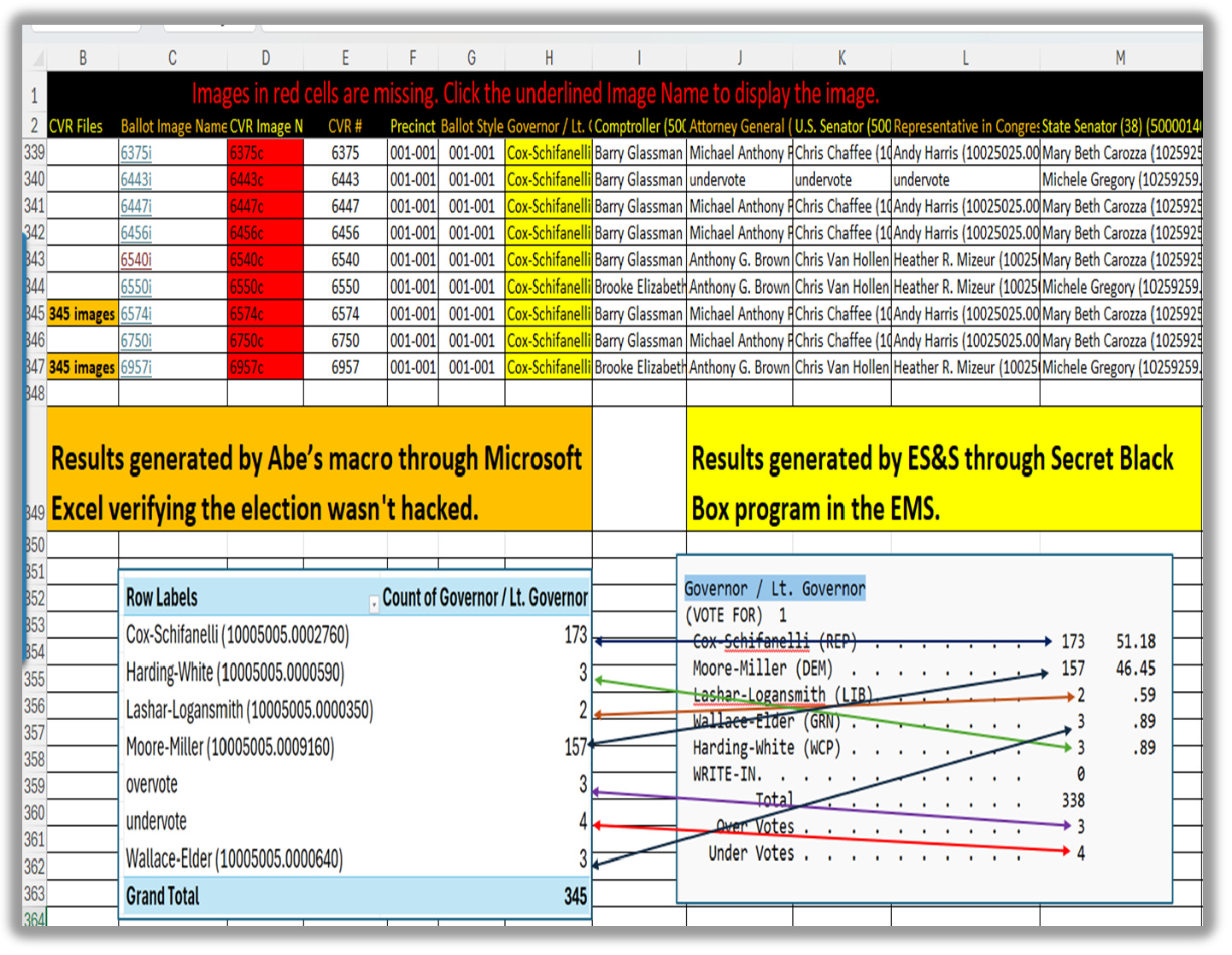
The important point is that modern digital scanners produce two separate records:
• the ballot image — the visual record of the ballot
• the CVR — the machine’s interpretation of that ballot
Because both records exist, they can be compared. If the voting system interpreted the ballot correctly, the CVR should match what is visible on the ballot image.
XI. From Optical Mark-Sense to Digital Scanning
Earlier generations of voting systems used optical “Mark Sense” scanners. These systems relied on a simple light-detection process. A light source—typically an LED—was directed at the area where a voter would mark an oval or box. If the light reflected back, the system interpreted that area as blank. If the light was absorbed by a dark mark, the system recorded a vote.
While effective at detecting marks, these optical mark-sense systems did not create or store an image of the ballot. The scanner detected the mark and recorded the vote, but it left no visual record behind showing what the machine had actually seen.
Modern voting systems work differently.
Today’s digital ballot scanners capture a full digital image of each ballot as it is scanned. The software then interprets that image and records the results in the CVR database.
This means modern systems produce both the visual record (the ballot image) and the tabulation record (the CVR).
Because both records exist, they can be compared and independently verified.
That combination—ballot images plus cast vote records—creates a far stronger evidentiary record than earlier optical mark-sense systems ever provided.
It also makes independent verification of election results far more feasible.
Why This Matters
Because the ballot image shows what the scanner saw, and the CVR shows how the machine interpreted that ballot, the two records together allow election verification to move beyond trust and toward evidence that can be independently examined.
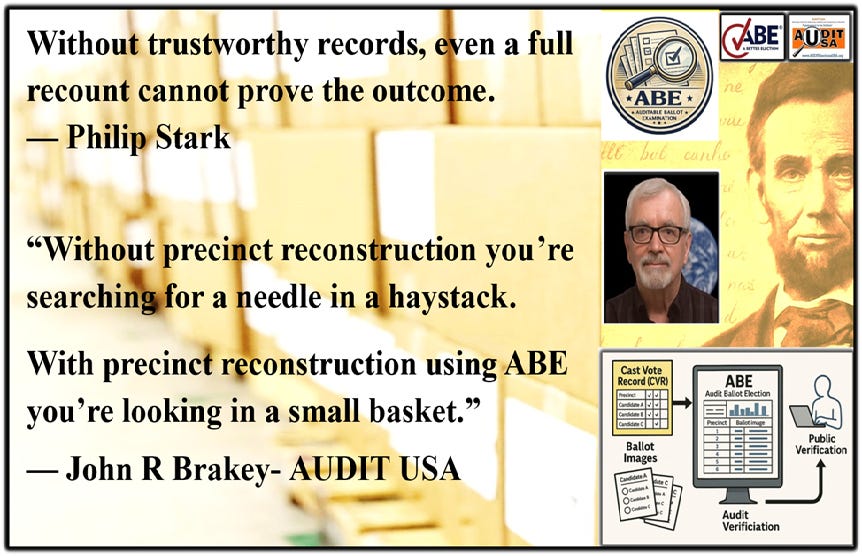
These records make it possible to reconstruct election results precinct by precinct—turning what would otherwise be a search through a haystack into a small basket investigators can examine directly.
Why Comparing Ballot Images and CVRs Matters
The power of modern election verification comes from comparing these two records.
Ballot images show what the ballots look like. CVRs show how the machines interpreted those ballots.
If the system is functioning correctly, the two records should match.
When they match, observers can confirm that the machines counted the ballots correctly.
If they do not match, discrepancies become immediately visible and can be investigated.
This comparison is one of the clearest ways to move from trust-based elections to evidence-based elections.
XII. Are Ballot Images Anonymous?
One common concern about releasing ballot images is voter privacy.
Some people worry that if ballot images are made public, someone might be able to determine how individual voters voted.
That concern sounds reasonable.
But the best available research shows it is largely overstated.
A 2025 study published in Science Advances by Shiro Kuriwaki, Daniel Lewis, and Michael Morse examined the 2020 election in Maricopa County, Arizona, the fourth-largest county in the United States.
The researchers found that releasing individual ballot records would reveal no vote choice for 99.83% of voters.
“In the largest U.S. county studied, releasing ballot records would reveal vote choices for only 0.17% of voters.”
The small fraction of potential privacy risks — about 0.17% of ballots — typically involve special cases such as:
certain ballot styles
provisional ballots
federal-only ballots (Arizona)
However, concerns about these rare edge cases have sometimes been cited as a reason to restrict public access to ballot images and related election records.
In some jurisdictions, officials have argued that every ballot would need to be individually reviewed to ensure anonymity before records could be released. In one Florida case, officials estimated that performing such a manual review could cost hundreds of thousands of dollars.
But modern tools make that kind of manual process unnecessary.
Because ballot images and cast vote records are digital data, software can quickly identify the small number of ballots that might present anonymity concerns—such as unusual ballot styles or provisional ballots. Those rare cases can then be handled through straightforward procedures such as redaction, grouping, or exclusion from public datasets.
In other words, protecting voter anonymity does not require blocking transparency.
With the right tools and procedures, election administrators can both protect voter privacy and provide the public with the records needed to verify election results.
Modern election systems increasingly use ballot-on-demand printing, which allows most voters to receive identical ballot styles. When unusual ballot styles occur — typically for small local contests — election officials can address them with simple administrative solutions, such as printing a one-off ballot.
The key point is simple:
Ballot transparency and voter privacy are not in conflict.
With proper procedures, elections can release the anonymous records needed for verification while fully protecting voter anonymity.
And that matters enormously, because transparent elections require evidence that the public can examine.
XIII. When Elections Become Messy
The reality is that elections are run by human beings, and human systems can become messy—especially under extraordinary circumstances.
The 2020 election in Georgia is a good example.
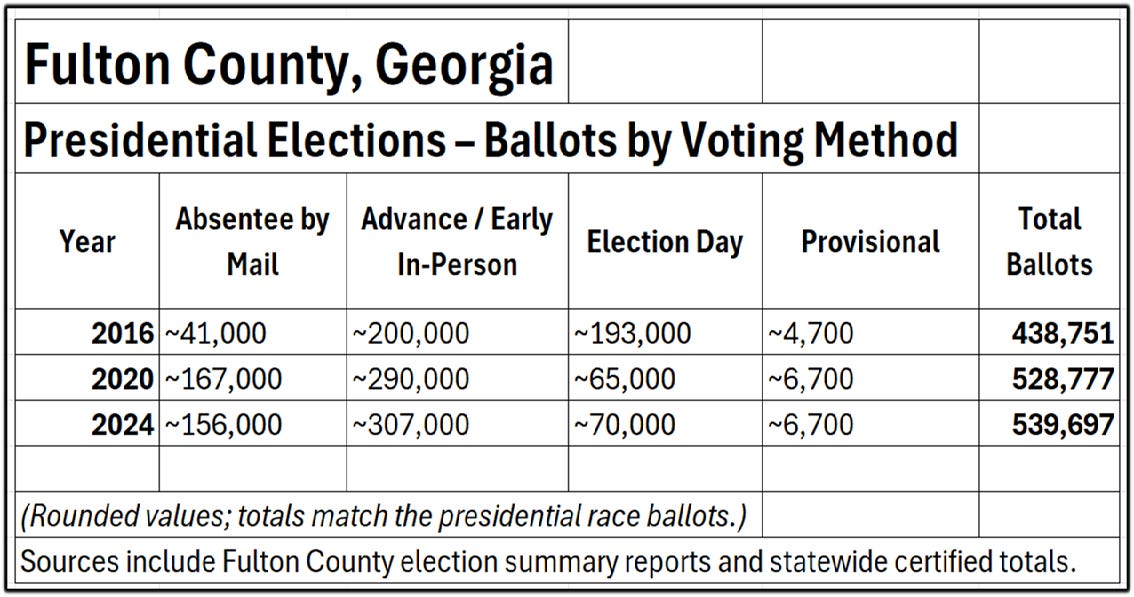
The COVID pandemic forced many jurisdictions to shift rapidly from traditional precinct voting to large-scale vote-by-mail processing. Ballots arrived through new channels, procedures were changed quickly, and election offices were working under enormous pressure.
On top of that, election administration is not something that happens every day. Large elections occur only every couple of years. When major procedural changes happen suddenly—as they did in 2020—it is not surprising that recordkeeping and reconciliation can become difficult.
In Fulton County, those stresses appear to have produced what many observers now see as a confusing and poorly documented process. Multiple counts were conducted, including a full hand count, but questions about records and documentation continued to surface.
Importantly, confusion in records does not automatically mean fraud occurred.
What it means is something else:
the system lacked the tools needed to quickly reconstruct what happened.
XIV. The Shock to Georgia’s Election System
Georgia’s Voting System Was Hit by a Historic Shift (2016 → 2020)
Georgia’s 2020 election occurred under extraordinary circumstances. In the 2016 presidential election, Georgia processed only 207,716 absentee-by-mail ballots. In 2020, that number surged to 1,316,943 ballots—an increase of more than 1.1 million mail ballots in a single election cycle.
Election systems that had previously handled hundreds of thousands of mailed ballots suddenly had to process more than a million. Procedures were modified rapidly, election offices were operating under pandemic restrictions, and many jurisdictions were handling volumes of mail voting they had never experienced before.
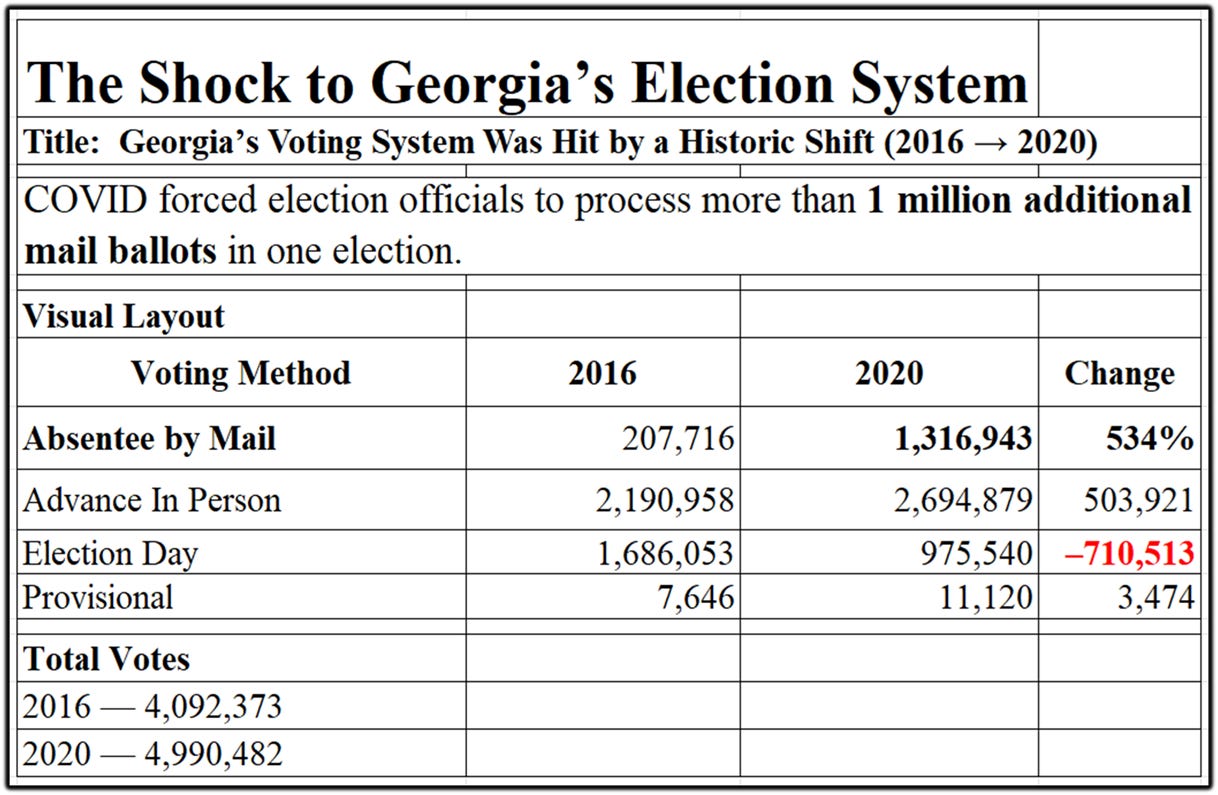
This historic shift helps explain why recordkeeping and reconciliation challenges emerged in some jurisdictions. As Stark’s analysis suggests, the key question is not simply whether mistakes occurred, but whether the election system produced records strong enough to reconstruct what happened and verify the outcome with confidence.
Why Precincts Are the Building Blocks of Election Verification
When investigators try to understand problems in a large election, looking only at the total vote is like searching for a needle in a haystack.
The key is to return to the basic building blocks of elections: precincts.
Every precinct has a known number of voters and a known number of ballots. When those numbers do not reconcile, investigators immediately know where to look.
But modern elections often mix ballots from many precincts into large tabulation batches. A batch of 200 ballots may contain ballots from dozens—or even hundreds—of different precincts.
If one batch is accidentally scanned twice, the resulting error can spread across many precinct totals. That makes it extremely difficult to diagnose the problem using traditional methods.
This historic shift helps explain why recordkeeping and reconciliation challenges emerged in some jurisdictions. As Stark’s analysis suggests, the key question is not simply whether mistakes occurred, but whether the election system produced records strong enough to reconstruct what happened and verify the outcome with confidence.
XV. Why Precincts Are the Building Blocks of Election Verification
Precincts are the smallest units of election administration where ballots are cast and counted. Because each precinct has a defined number of voters and ballots, verifying results at the precinct level allows investigators to detect discrepancies in a clearly defined area.
In short, precincts turn a very large election into smaller, verifiable pieces.
When investigators try to understand problems in a large election, looking only at the total vote is like searching for a needle in a haystack. The key is to return to the basic building blocks of elections: precincts.
If 1,500 voters participated in a precinct, the system should confirm that 1,500 ballots were counted. When those numbers do not reconcile, investigators immediately know where to begin looking.
Modern elections, however, often mix ballots from many precincts into large tabulation batches. A single batch of about 200 ballots may contain ballots from dozens—or even hundreds—of different precincts. If one batch is accidentally scanned twice, the resulting error can spread across many precinct totals, making it difficult to identify the source of the problem using traditional methods.
Rebuilding the Election from the Evidence
Modern voting systems produce two digital records that make reconstruction possible:
• Ballot images — digital images of each ballot as it was scanned
• Cast Vote Records (CVRs) — the machine’s interpretation of each ballot
By analyzing these records together, it becomes possible to rebuild election results precinct by precinct—even when ballots were originally processed in mixed batches.
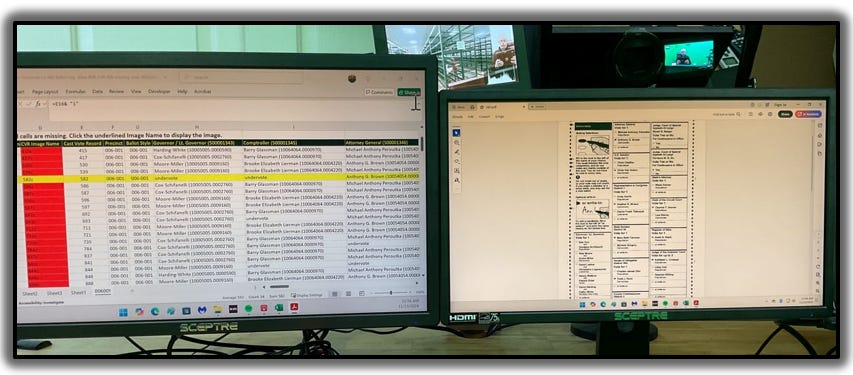
Once precinct-level totals are reconstructed, discrepancies become much easier to identify. Instead of searching blindly through hundreds of thousands of ballots, investigators can quickly pinpoint the specific precinct—or batch of ballots—where something went wrong.
In other words, what would otherwise be a search through a haystack becomes a much smaller basket investigators can examine directly.
XVI. Speed and Accuracy
Traditionally, election officials have faced a difficult choice during post-election reviews: speed or accuracy.
Manually reconstructing precinct results from physical ballot boxes can require opening hundreds of boxes and sorting through thousands of ballots.
Modern analytical tools change that.
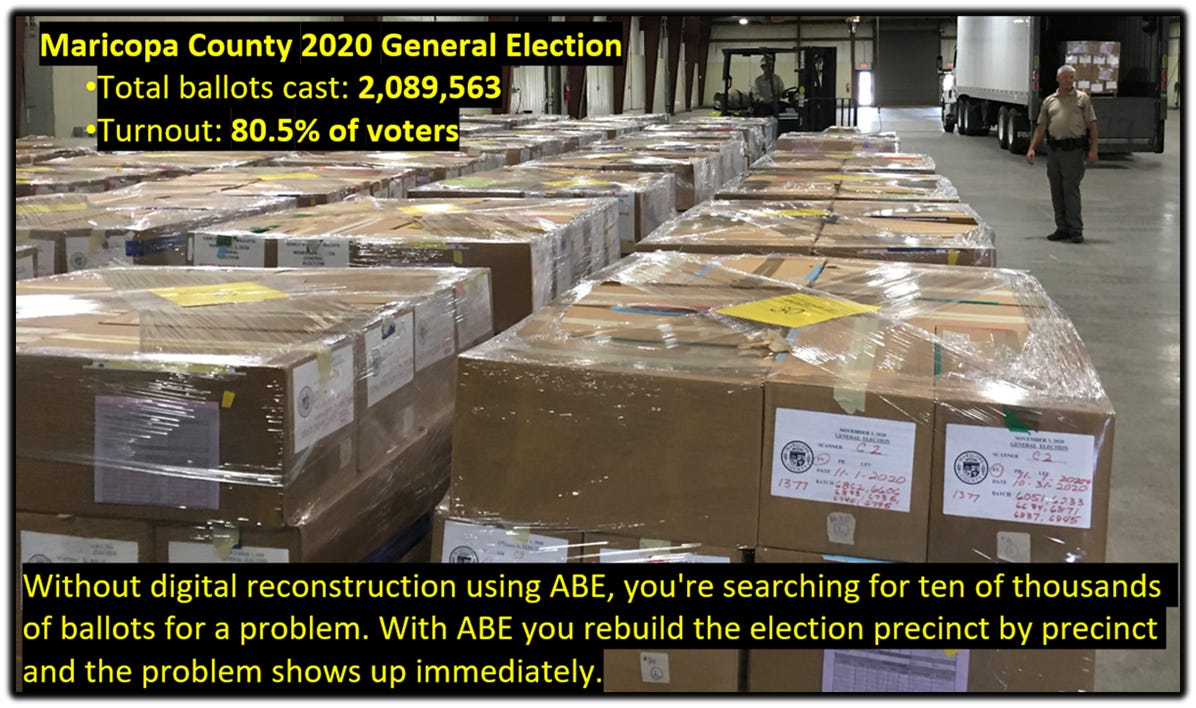
Using ballot images and CVR data, systems such as Auditable Ballot Examination (ABE) can reconstruct precinct-level results in minutes rather than days.
This does not replace the original ballots.
The paper ballots remain the official record.
What it provides is something election officials rarely have during a controversy: the ability to quickly locate potential problems and verify results with precision.
XVII. Cleaning Up the Mess
The lesson from Georgia is not that elections are hopelessly flawed.
The lesson is simpler.
Elections can become messy—especially during extraordinary events like the pandemic.
But when the underlying digital records are preserved and analyzed correctly, investigators can rebuild the election from the evidence.
That process turns confusion into verification.
And it transforms what might otherwise become election theater into something far more important:
elections that can be publicly verified.
XVIII. Transition to Precinct Verification
Conducting comparisons at the precinct level allows investigators to efficiently detect any imbalances and systematically trace them to their origin.
Once the first affected precinct is identified, the source batch can often be located quickly—even if that batch distributed ballots across many precincts.
This is another strength of the Auditable Ballot Examination (ABE) approach. Election officials are often forced to choose between speed and accuracy during post-election reviews. ABE helps provide both.
In short, precinct verification allows election officials to move from guesswork to targeted investigation.
Modern election records make this process far easier than it once was. With access to ballot images and cast vote records (CVRs), discrepancies can often be identified quickly, transparently, and independently.
ABE can process a countywide CVR file and reconstruct precinct-level results from the underlying ballot records in 10 minutes. For example, in a county with roughly 375,000 voters and about 350 precincts, ABE can generate a complete CVR database and produce precinct-by-precinct CVR reconciliation reports, each linked back to the underlying ballot record in under one hour. John Brakey
That allows auditors and observers to move immediately to the precinct where a discrepancy appears, rather than searching blindly across the entire election dataset.
In other words:
Precinct-level verification turns election auditing from guesswork into a precise diagnostic tool.
XIX. Ken Bennett’s Five Checks for a Verifiable Election
Former Arizona Secretary of State Ken Bennett proposes five simple questions every election should answer.
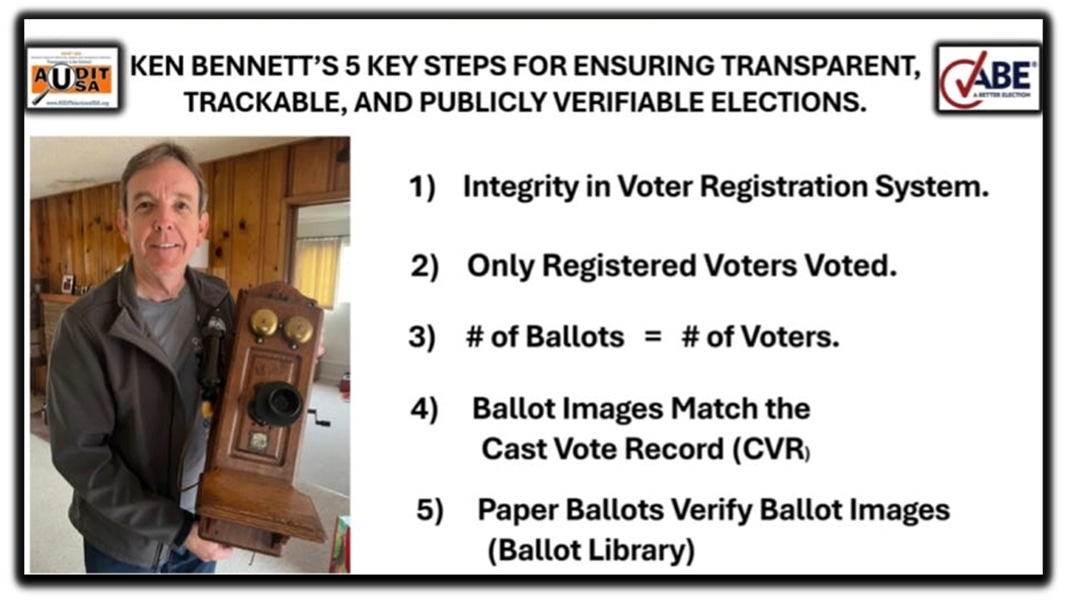
1. How many people voted? Every election should have a clear total number of participating voters.
2. Are they on the voter participation list? The participation record should match the list of voters who cast ballots.
3. Do ballots equal voters? If 10,000 people voted, there should be 10,000 ballots.
4. Do ballots match the machine tabulation? The votes recorded by the machines should match the votes visible on the ballots.
5. Can observers verify a sample of the original ballots? Independent observers should be able to review a sample of physical ballots to confirm they match the digital records.
They are the most basic questions an accountable election should be able to answer.
When they can be answered clearly, elections move beyond trust and into verifiable evidence.
From Election Theater to Public Verification
This is where Auditable Ballot Examination (ABE) comes in.
ABE allows independent verification using two records that most modern voting systems already produce:
ballot images
cast vote records
By organizing those records by precinct, observers can compare what the ballots show with how machines interpreted them.
If the records match, confidence increases.
If discrepancies appear, they can be investigated.
ABE allows observers to verify the evidence directly.
That is the difference between a closed election system and a transparent one.
And that is the difference between election theater and public verification.
XX. The Opportunity for Transparent Elections
Dr. Stark’s research shows the danger of audits that cannot verify underlying records.
Ken Bennett’s framework shows the basic checks needed for accountability.
ABE shows how those checks can actually be performed.
Jurisdictions such as Pima County and Cochise County, Arizona now have an opportunity to move beyond debates about trust and toward transparent verification.
This approach does not require new voting machines.
It simply requires using the records that already exist.
Because in a democracy, election results should not depend on trust alone.
They should depend on evidence that anyone can examine.
That is the future of verified elections.
Not endless partisan warfare.
Evidence. Transparency. Verification.
XXI. Final Thought
One lesson from Dr. Philip Stark’s work is clear: strong verification depends on strong records.
Audits cannot compensate for weak documentation or incomplete evidence.
But when election records are transparent and verifiable, democracy becomes stronger—not because officials say the outcome is correct, but because the public can examine the evidence for itself.
The Central Finding
“The real question about elections is not simply who won. The question is whether the election system produced records strong enough to prove the result with evidence.” -
John R Brakey
AUDIT Elections USA
INFORMATION SHEET ON OUR CURRENT EFFORTS TO STRENGTHEN OUR DEMOCRATIC REPUBLIC THROUGH A HEALTHY DEMOCRACY
The United States is both a constitutional democratic republic and a representative democracy. Effective election policy should recognize and strengthen both traditions rather than frame them in opposition.
For more than two decades, AUDIT USA (auditelectionsusa.org) has worked to protect something simple but essential: the public’s ability to see, verify, and trust our election records.
We remain on the front lines in the fight for meaningful election audits that can actually verify election results. The work we do is not flashy, but it is consistent and important:
1. We recently achieved a hard-fought victory in Florida, where our 8-year lawsuit was recently resolved with the Supervisor of Elections in Miami-Dade County, the 7th largest elections jurisdiction in the United States. Miami-Dade County has agreed to save ballot images for all future elections. Until now, Miami-Dade County has deleted ballot images, destroying this vital audit record. The attorneys who have stood by this important case issued a Press Release (link) in which they specifically recognized AUDIT USA, who was the initiator of this lawsuit and an ongoing partner behind the scenes. John Brakey, AUDIT USA Executive Director, and Susan Pynchon, Research Director, have met with this dedicated team of attorneys by Zoom almost every Saturday for 8 years.
While other Florida counties, such as Volusia County, have been saving ballot images for years, the remaining 7 largest counties in the state are still destroying them, so we have more work to do! We will now be educating the 7 remaining largest counties in Florida to convince them to join Miami-Dade in saving ballot images. If they don’t agree, our team of attorneys is prepared for further litigation. We will eventually win those cases because federal law, state law, and good election practices require saving these important election records. We need funds to support this effort and pay our attorneys.
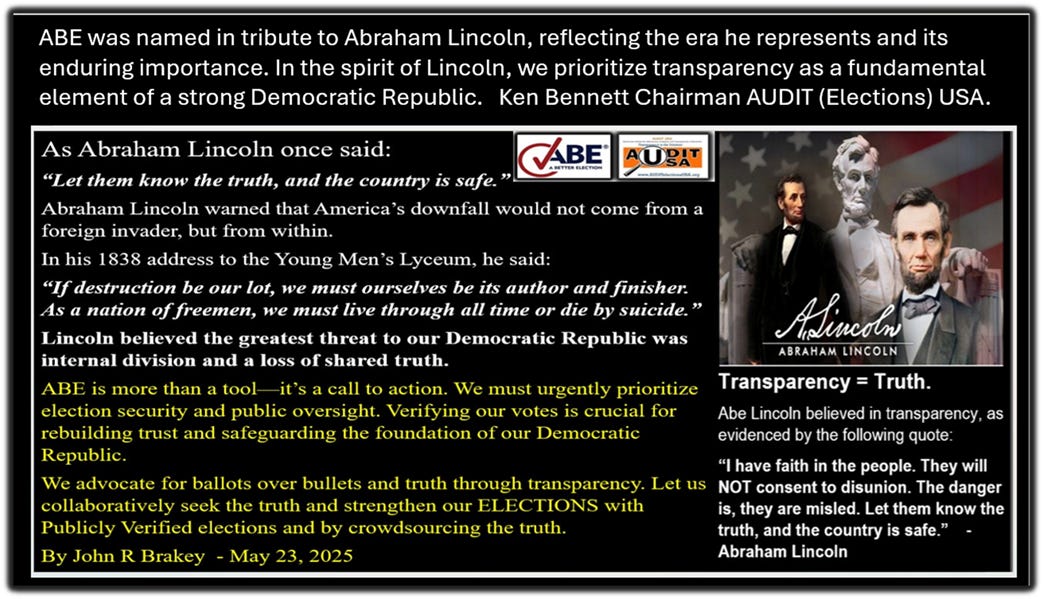
2. We have developed a ballot-image audit system, which we have named ABE after Abraham Lincoln, who believed in the public’s right to the truth. ABE stands for Auditable Ballot Examination. It is a software program that allows election officials, candidates, researchers, journalists, and voters to verify election results. We are offering this system at no cost because it is in keeping with our mission of transparent, trackable, and verifiable elections. We believe that ABE will revolutionize election verification as it becomes better known and better understood. We need funds to travel to election offices to demonstrate this revolutionary audit program.
3. Ken Bennett, former Arizona Secretary of State and former President of the Arizona Senate, has joined our board as Board Chairperson. He and our Executive Director, John Brakey, have formed a true nonpartisan alliance, sharing their passion for transparent, trackable, and verifiable elections. Ken and John are preparing to meet with Secretaries of State and election officials around the country to explain the importance of ballot images as an audit record and also to demonstrate ABE to them. Some of their meetings will be by Zoom and others will be in person. We need funds to commence Ken and John’s outreach program.
4. We had an important victory at the Arizona Court of Appeals in the lawsuit Santa Cruz County vs. AUDIT USA and John Brakey. Three years ago, John Brakey requested election records from Santa Cruz County, including the Cast Vote Record – records the county had freely provided in the past. Santa Cruz County promised to provide the requested records and then, on the same date they had promised to provide them, they sued AUDIT USA and John Brakey, asking the court for a declaratory judgment as to whether the Cast Vote Record is a public record or not. This unjustified and unwanted lawsuit has drained our energy and our resources for 3 years. The county initially lost in Superior Court, where the judge told them their lawsuit was “outside the bounds of public records law.” However, the county’s high-paid private law firm found ways to appeal 3 more times to the Arizona Court of Appeals. They lost all 3 times but now are trying to avoid reimbursing us for the legal fees incurred by our attorneys.
5. We are involved in court cases and many issues around the U.S. With our collective knowledge about elections, developed over two decades of work studying election processes and observing actual elections, we often act as mentors, advisors, and advocates for election integrity activists around the country. Our small staff often works 7 days a week. We need funds to continue paying them a modest salary.
6. Our website is full of important information and hundreds of important archived articles and videos, but many of those are hard to access. We need funds to pay for someone to help us bring our website up to date.
We’re a nonpartisan, nonprofit 501(c)(3) organization. Founded in 2005 as AUDIT AZ. We have focused on transparency and accountability in elections—especially the preservation and public release of ballot images. Around the country, we’ve shown up when it matters: pushing back against needless secrecy, advocating for record retention, litigating to prevent the destruction of vital election records, and making the case that transparent, auditable elections strengthen confidence for everyone, regardless of party.
Legal filings, public-records requests, technical research, and rapid-response advocacy require real resources. And right now, we’re at a point where additional support will directly determine how much we can do in the months ahead: how many fights we can take on, how quickly we can respond, and how effectively we can keep ballot images and other election records from being lost, deleted, or withheld.
The public should be able to verify election outcomes. We are at a tipping point on so many issues and your support will allow us to continue our important work.
Donate:
AUDIT USA is a 501(c)(3) nonprofit; donations are tax-deductible as allowed by law.
Send donation check to:
AUDIT USA P.O. Box 26361
Tucson, AZ 85726
Or donate online:
www.AUDITElectionsUSA.org/donate/
John R. Brakey
Executive Director, AUDIT Elections USA
Co-Developer of the ABE Hybrid Verification System
Election Transparency Investigator, Educator & Reform Advocate 520-339-2696
JohnBrakey@gmail.com Link to this story on John Brakey Substack
Resources:
ABE Brochure: https://bit.ly/3Svn7n4
ABE User Manual: https://bit.ly/3yZrKPi
Link to “They Sued Us for Asking”: https://johnrbrakey.substack.com/p/they-sued-us-for-asking-inside-santa
AUDIT USA Launches Free Election Verification Tool ‘ABE’ — By Jonathan Simon (This tool promotes election integrity by providing evidence-based transparency, potentially curbing misinformation related to election fraud.
How a “Small” Decision in Miami-Dade Could Transform Election Transparency Nationwide - Why a Quiet Legal Victory in Florida Could Help Restore Trust in American Elections Rev. 1/28/26
Open Letter to Supervisors Davis and Fanning — A Public Message to the
Citizens of Santa Cruz County, Arizona Subtitle: Transparency and accountability form the cornerstone of public trust. These principles are more important than ever. Rev 1/28/26
AUDIT USA Launches Free Election Verification Tool ‘ABE’ — Jonathan Simon
Part 3 of 3: Voter Data, Centralized Power, and the Future of Our Democratic Republic - Subtitle: How Citizens Can Regain Power: The Importance of Transparency, Verification, and Courage—Why Election Legitimacy Requires More Than Blind Trust Dec 29, 2025 By Ken Bennett & John Brakey
Chapter 4 —A Special Report: The Golden Rule of Democracy: Voting is Secret, Auditing must be Publicly Verifiable by Precinct with digital ballot. The Hidden History of Election Chicanery ABE: Hybrid System for Transparent, Trackable, Publicly Verified Elections. ABE (Auditable Ballot Examination)
Former Arizona Secretary of State Ken Bennett: Five Steps to Achieving Verified & Trusted Elections: Democracy Relies on Trust and Verification. Jul 31, 2025
Donate: AuditElectionsUSA.org/donate
AUDIT USA is a 501(c)(3) nonprofit; donations are tax-deductible as allowed by law.
Send donation check to:
AUDIT USA P.O. Box 26361
Tucson, AZ 85726
Or donate online:
www.AUDITElectionsUSA.org/donate/
We appreciate donations of any size.
Thanks for reading John’s Substack! Subscribe for free to receive new posts and support my work.