
Special Public Accountability Report: Before the $2.67 Billion Vote — The RTA Transparency Lessons Pima County Residents Can’t Afford to Ignore
An in-depth examination of the legal proceedings revealed significant transparency deficiencies within the RTA in 2006—and the imperative for public verifiability in the March 10, 2026 bond election
By John R. Brakey
Release date: March 3, 2026 updated 3/26/2026 3PM
Full Investigative Report & Media Assets:
PRESS RELEASE FOR IMMEDIATE RELEASE 3.5.2026
APPENDIX A: To Board of Supervisors’ Role During the Canvass
AUDIT USA Special Public Accountability Report: On the $2.67 Billion Vote
The Timing Question: Why is there a $2.67 billion vote scheduled for March?
3-Minute Promo - FATALLY FLAWED: What the 2006 Pima County RTA Fight Still Teaches Us after 20 Years:
First Publish on Three Sonorans: News from the Borderlands Resistance
By John R. Brakey
Release date: March 3, 2026
A Forgotten Moment That Should Never Be Forgotten. Thank you Mike Hayes
Updated March 26, 2026 3PM
In preparing this report, I was reminded of something I had not thought about in years—until a message from a longtime colleague and friend, Mike Hayes, brought it back into focus.
Mike was there in the early days of the 2006 RTA election challenges. He was not an outsider looking in—he was part of the effort to understand what had happened.
And what he reminded me of is not incidental.
It is extraordinary.
As Mike recently wrote:
“I was sure from the moment Pima County announced in court that all employees of the election department would be taking the Fifth rather than answer questions under oath. I was sure a lot longer than that, as they persisted in hiding the ballots…”
That moment deserves to be understood for what it was.
In open court, when asked to account for the handling of an election, the response was not transparency—it was silence under oath.
Not one employee.
All employees.
That is not a routine legal posture.
That is a signal.
And it reinforces a pattern that defined the 2006 RTA controversy:
resistance to disclosure, barriers to inspection, and a system that could not—or would not—be independently verified.
Mike’s reflection goes further:
“I’m still inclined to believe the result was manipulated, but I’m not so certain the result was changed… Election fixing has moved well beyond one employee with an illegally open Microsoft manual and a wire from the computer counting the ballots to a locked room, the contents of which were not known.”
That observation matters today.
Because the issue before us is not simply what may have happened in 2006—it is what we have learned since.
Technology has changed.
Systems have evolved.
But the core question has not:
👉 Can the public independently verify that election results are correct?
That is the question that remains unanswered.
And that is why this history matters.
Not as accusation.
Not as speculation.
But as context.
Because when a system resists transparency in the past, it creates an obligation for transparency in the present.
Thanks, Mike, for the reminder. I suppose I’m getting older too. Eventually, all of this will be included in a book written by former Secretary of State Ken Bennett and me.
The RTA Cases started in 2006. How Transparency Was Fought, Why It Mattered, and What We Learned over almost nine years and litigation.
Fatally Flawed: The Pursuit of Justice in a Suspicious Election is a two-hour investigative documentary that follows the long legal battle over the 2006 Pima County RTA bond election. Through courtroom evidence, public records fights, and on-the-ground reporting by attorney Bill Risner, John Brakey, and Arlene Leaf, the film examines allegations that key election records were hidden, altered, or suppressed and shows how citizens seeking answers encountered sustained institutional resistance. What begins as a routine inquiry into missing poll tapes evolves into a broader case study of transparency gaps, oversight failures, and the difficulty of verifying election outcomes after the fact—ultimately arguing that meaningful public verification must be built into election systems before certification.
The image below shows what is commonly referred to as the zero report.
According to Election Director Brad Nelson (see video below), the computer operator’s Illegal entry into the system was necessary because the report had not been completed and the system had not been properly zeroed. However, the video I recorded at 10:31 AM documents that the zero report had already been produced.
Later that afternoon, system access occurred with the stated justification that it was required to reset or zero out the system—a task that, under normal procedure, could have been performed the following morning prior to the start of vote counting.
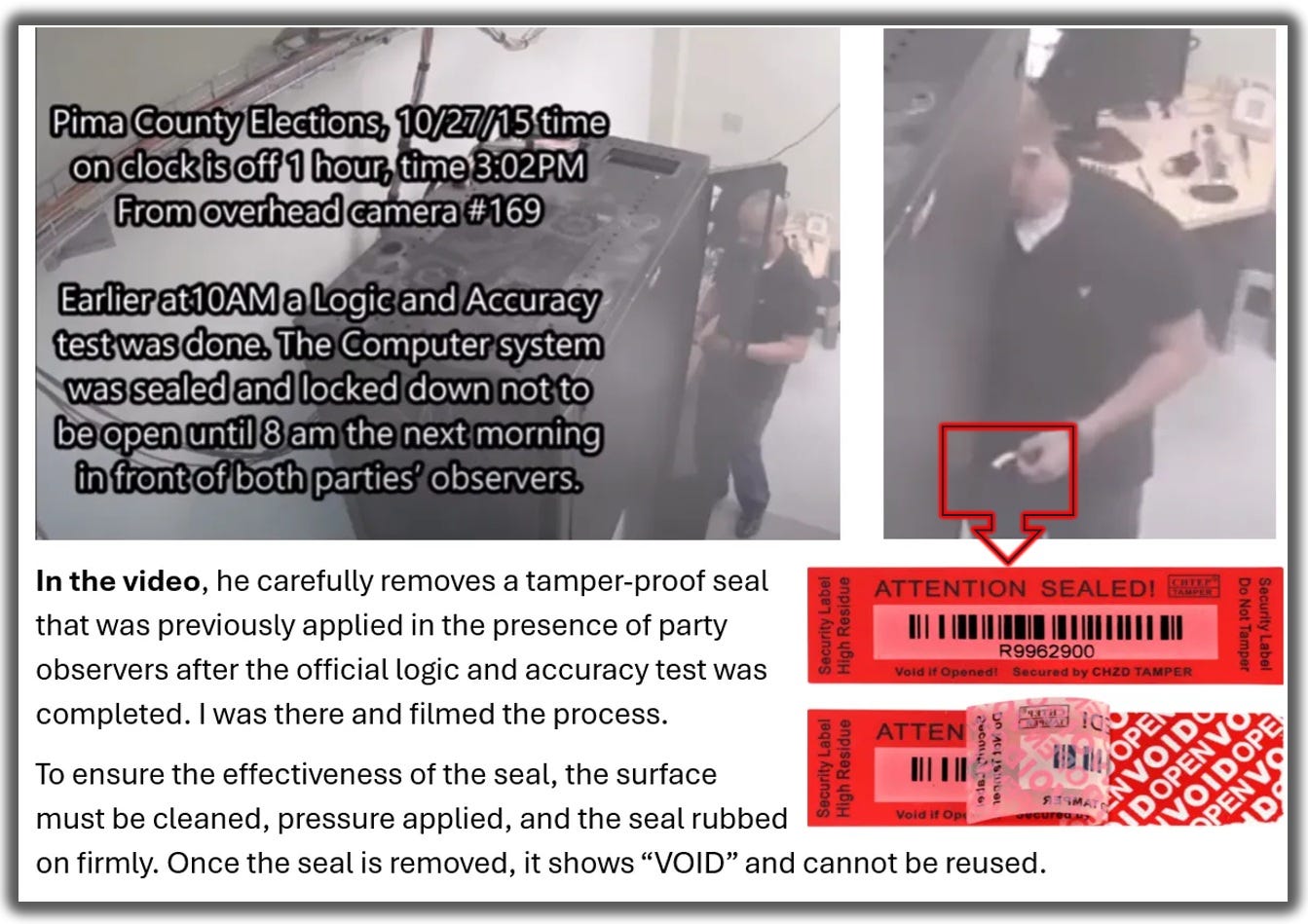
The video appears to show the tamper-evident seal being removed very carefully and was to be reattached in a manner that may not have been apparent to observers. Observers noted the following morning that the seal number matched the one previously applied. These seals carry unique identifiers and are designed to display “VOID” if removed. The condition visible in the footage raises questions about whether the seal was properly adhered to when originally applied.
In addition, the entry shown on the recording does not appear to follow the two-person access protocol (where each individual holds part of the password), which was the stated security procedure.
It is important to note that these events occurred in 2015, at a time when public awareness of election system vulnerabilities was far lower than it is today. Following the highly contested 2016 presidential election, national attention to election integrity issues increased significantly.
Taken together, this video may constitute a potential “smoking gun” moment, that warrants clear explanation and independent verification — something that was not fully addressed at the time despite the concerns raised to that was never addressed (the lies told on video by Nelson” the cover up and with the complete loss of all 7 bond issues. John Brakey
The result: All seven bond measures failed.

In 2015, long before election security became a national flashpoint, this recording captured something that deserves fresh scrutiny. Officials later claimed the system had to be accessed because the zero report had not been printed. But the video tells a different story. At 10:31 AM, the zero report was already documented on camera. Hours later, the system was opened anyway. Watch the timeline carefully and decide for yourself what the evidence shows.
A zero report was logged at 10:31 AM—so what prompted the system to be accessed later? And what explains the apparent dishonesty and attempt to conceal the truth?
Pay close attention: the sequence of events reveals everything.
In 2015 Pima County Bond Election: How Citizen Oversight Exposed Critical Concerns and Hacking Attempt on video. Play video 11 minutes
“Political language… is designed to make lies sound truthful.”
— George Orwell
1. I want to begin with a simple disclosure about where I’m coming from, because facts and credibility matter.
The people involved in the actions described below are no longer working for the county or the election department. We do not mean to impugn the many dedicated professionals who work in elections — the vast majority of whom I consider colleagues.
“I am not asking anyone to simply trust my statements. What I encourage is examination of what has been properly documented, litigated, testified to under oath, and directly observed — frequently using the county’s own records, systems, and live video feeds.” John Brakey
The May 2006 Regional Transportation Authority (RTA) bond election in Pima County turned into an eight-and-a-half-year legal war. It consumed enormous public resources, strained relationships, and fundamentally changed how I understand elections and government accountability.
We did not set out to become election activists.
We set out to verify what happened.
The county’s reaction told the story.
2. Legal Context (Risner)
As election attorney Bill Risner later documented, the early litigation was not driven by a single party or perspective.
The original cases seeking access to Pima County election data were first filed by the Pima County Democratic Party. Much of the information later included in the Libertarian Party’s Initial Disclosure Statement was uncovered through that Democratic Party lawsuit seeking access to the Pima County Board of Supervisors’ historical election database.
The plaintiffs ultimately prevailed in that case, resulting in what Risner described as one of the largest releases of electronic election databases in the history of electronic voting.
According to Risner, the county’s resistance to releasing historical election data was unusually aggressive, raising concerns among the litigants about what the county was attempting to protect.
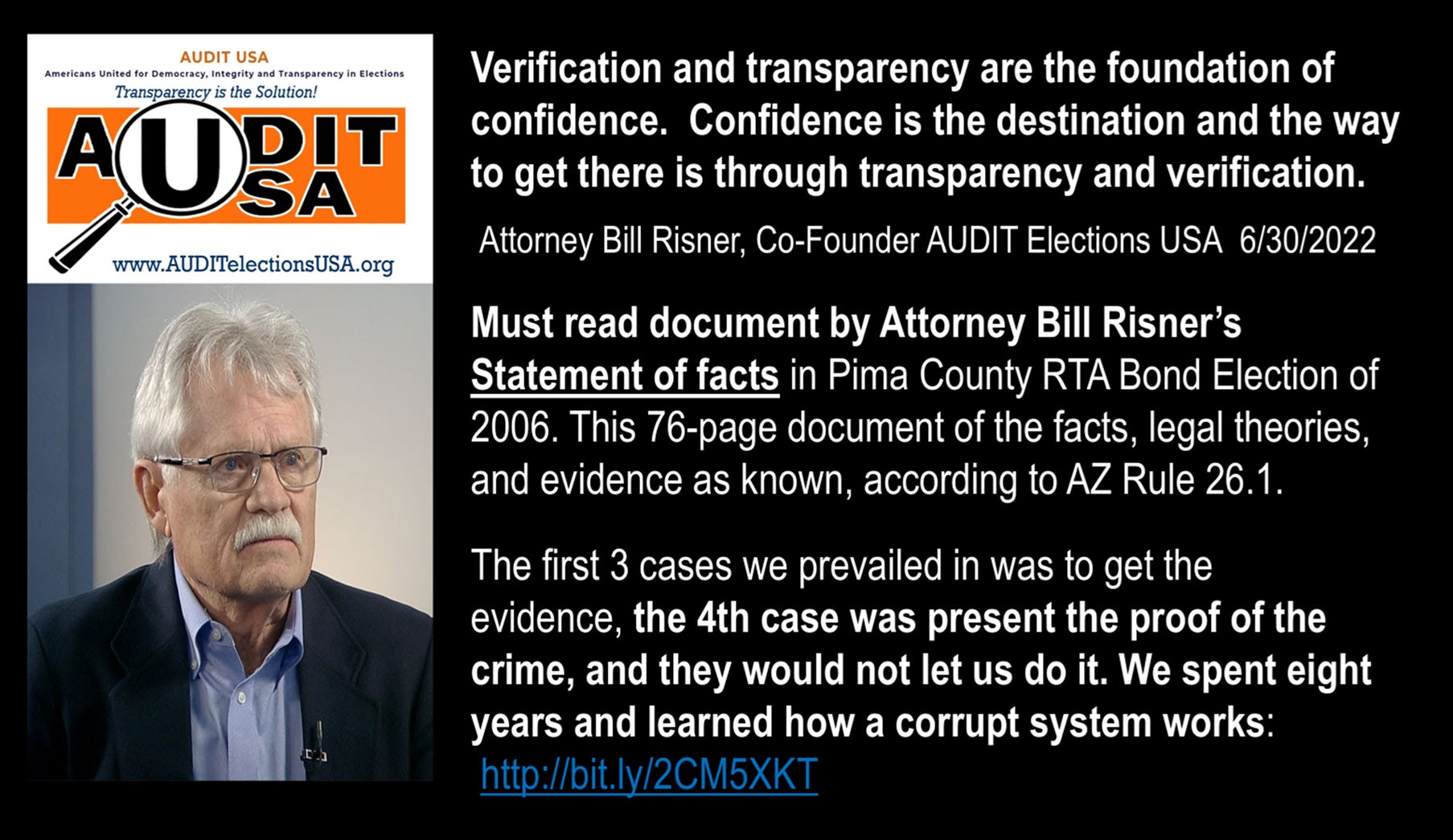
It was assumed that problems with the RTA election could not be thoroughly investigated, since the ballots were thought to have been destroyed according to the state’s six-month retention rule. Federal law requires ballots to be kept for 22 months.
However, it was later discovered that the RTA ballots had not been destroyed. Because of heightened public interest, the county instead sought judicial guidance on whether the ballots should be destroyed.
Rather than permit destruction, both the Democratic Party and the Libertarian Party asked the court to preserve the ballots and implement safeguards designed to prevent future election irregularities.
Risner’s broader conclusion was cautionary: election verification must occur before certification, because once results are finalized, courts are often reluctant to intervene — regardless of the underlying concerns.
3. Video of Attorney Bill Risner Explains How Election Fraud Works in Pima County (Tucson) Arizona
“The fundamental requirement of a democratic system is the public’s ability to determine accurately who received the most votes — and to rely on that determination with confidence.”
— Attorney Bill Risner (court argument)
In this courtroom argument from 2012, election attorney Bill Risner lays out a concern that still echoes today: whether computerized election systems can be independently verified in time to protect the public’s confidence.
Speaking during a critical motion hearing, Risner argued that when election technology becomes difficult to audit and even harder to challenge within statutory deadlines, courts have a duty to closely examine whether the constitutional “purity of elections” is being fully protected.
This is not a sound bite — it is a detailed legal argument presented on the record, explaining why the plaintiffs sought prospective relief and why the structure of election systems themselves can become central to public trust.
If you care about transparent, publicly verifiable elections, this is worth your time.
4. The “We Only Cheated Once” Argument
Front page of motion below: http://tinyurl.com/cp928z7
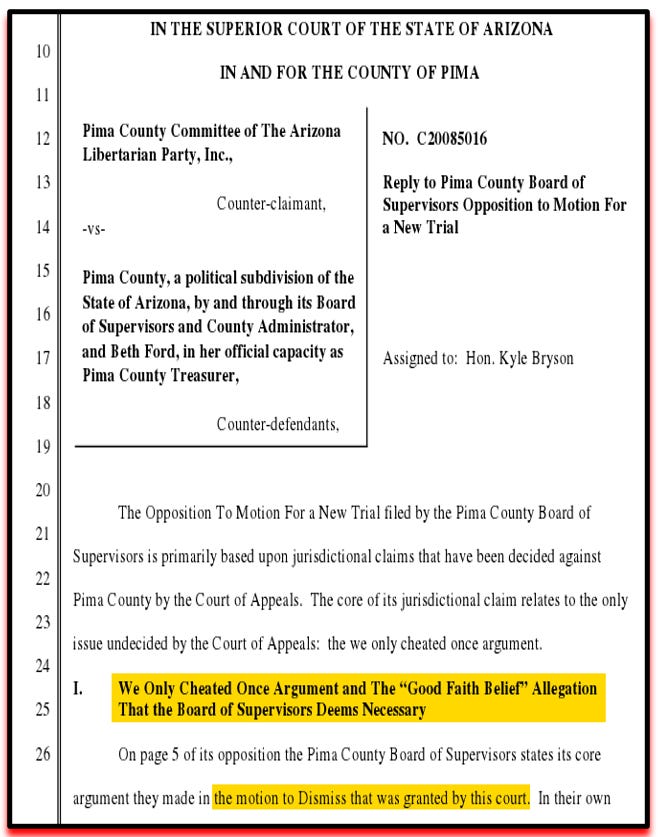
Risner says the County’s position boils down to this claim:
Even if fraud happened in 2006, plaintiffs have not shown a good-faith reason to believe it will happen again.
Risner calls this requirement absurd and explains why.
He argues: (in 2012)
The same Board of Supervisors
The same county administrator
The same computer operator
The same election structure are still in place
Therefore, the risk of recurrence is obvious and does not require speculative pleading.
His analogy (important)
He essentially argues:
If bank managers helped steal from the vault, you don’t need special proof they might steal again before putting safeguards in place.
This is one of the strongest rhetorical moves in the filing.
A) The Court Can Order Relief Before Discovery
The County argued the plaintiffs failed to specify exactly what injunction they want.
Risner responds:
Plaintiffs have not even had discovery yet.
Courts routinely craft appropriate remedies after evidence is developed.
There is no legal requirement to plead the exact final injunction in advance.
In plain English:
Don’t throw the case out before we even get to the evidence.
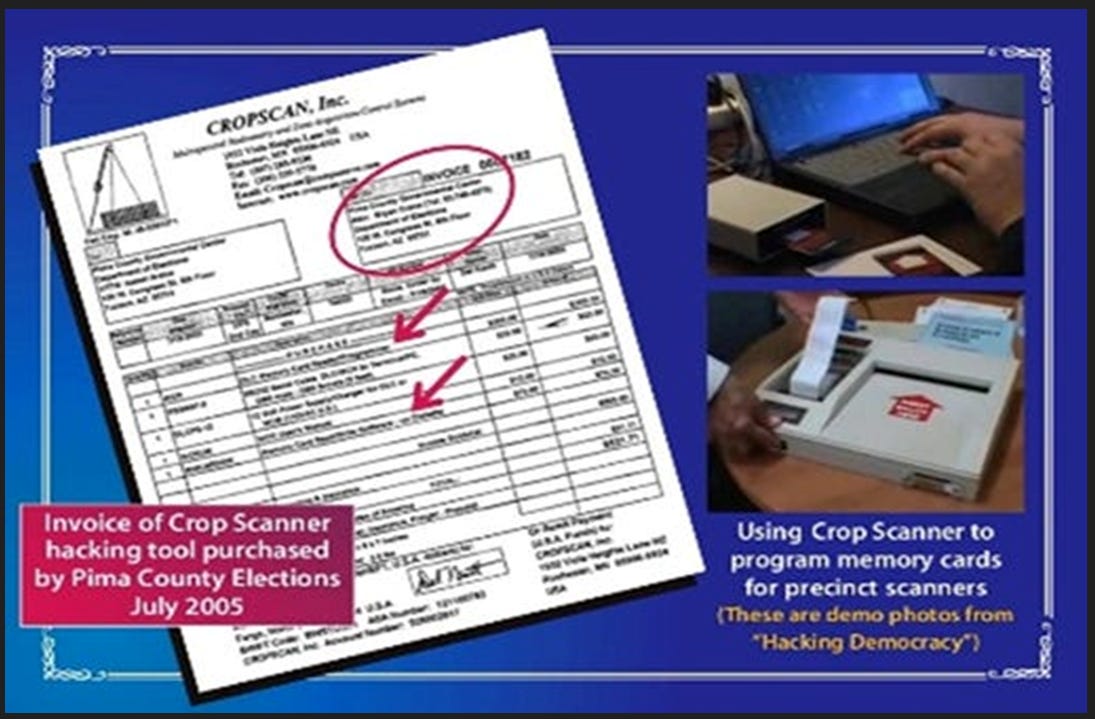
B) The “We Destroyed the Hack Tool” Defense
This section is particularly notable.
Video excerpt from HBO Hacking Democracy 2006 Pima County had the same device for hacking Elections:
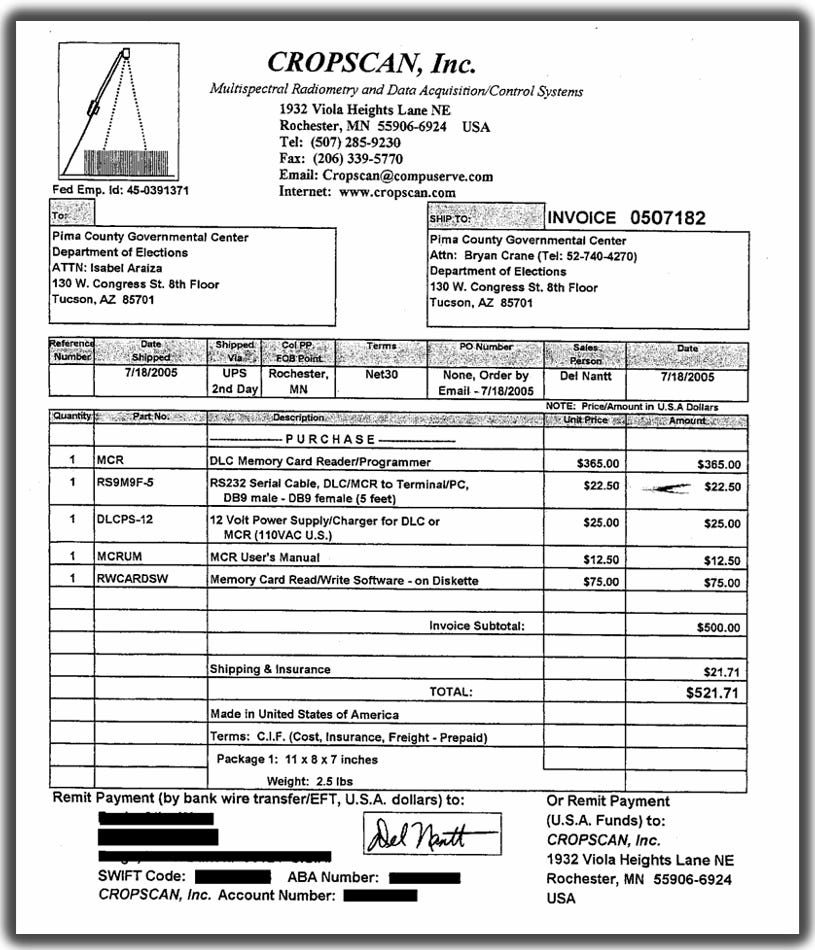
The County pointed to deposition testimony claiming it destroyed the controversial “Cropscanner.”
Risner’s response is blunt:
Destroying one tool proves nothing.
The County could simply buy another.
The key fact is that they did acquire such a device in the first place.
Why this matters
Risner frames the issue as:
Possession demonstrates capability and intent — not innocence.
This is one of the more provocative parts of the filing.
C) The County’s Case Law Arguments
The County cited several cases to support dismissal.
Risner methodically argues:
None of the cited cases actually apply.
The Court of Appeals has already ruled the trial court does have jurisdiction.
The County is trying to relitigate issues already decided.
This is classic appellate positioning.
D) The “Holy Trinity” Section
Risner says the County is attacking three core claims:
Claim 1
The County rigged the 2006 bond election:
County denies it
BUT admits the court must assume it true at this stage.
Claim 2
The court has a constitutional duty to protect election integrity.
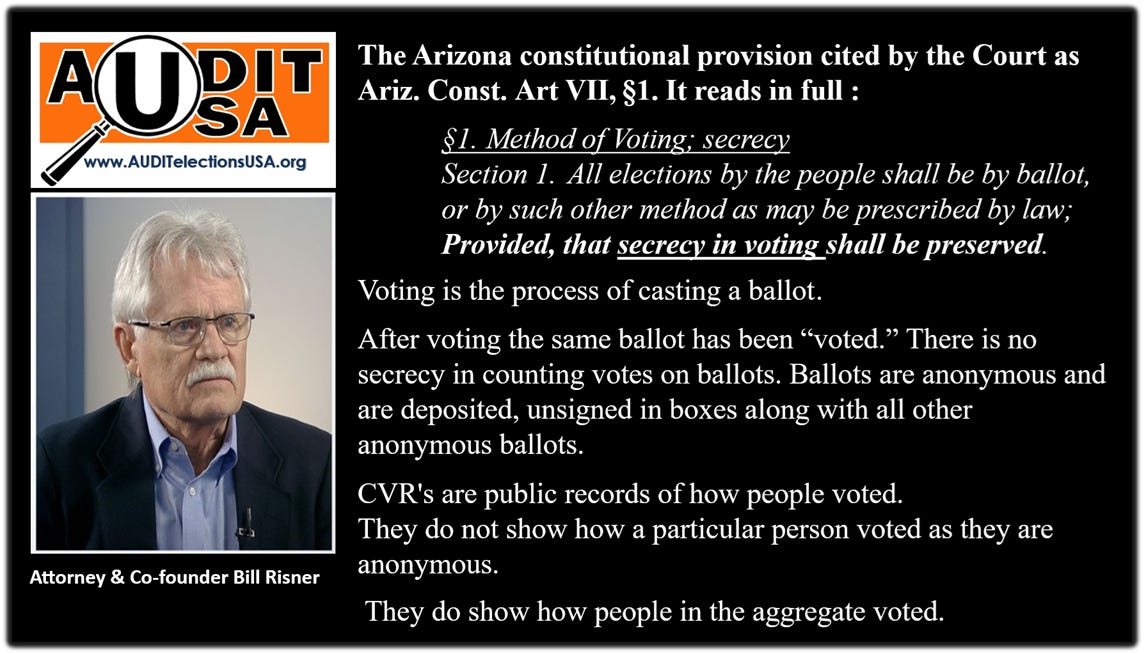
Risner notes the Court of Appeals already cited:
1. Arizona Constitution (Art. II §21) → guarantees free and equal elections
2. Arizona Supreme Court (Griffin v. Buzard) → emphasizes preserving the purity of elections
Together, they form the backbone of Arizona election-integrity law.
Claim 3
The Libertarian Party’s motives are suspect.
Risner’s response:
Political parties have a legitimate role in protecting elections.
Motive is legally irrelevant to the pleading issue.
5. Bottom-Line Conclusion of the Filing
Risner asks the court to:
Vacate its prior ruling
Allow the case to proceed
Permit evidence to be presented
because, in his view, the Arizona Constitution obligates courts to protect election integrity.
I. The County’s Own Framing
The County effectively argued:
At worst this was a single historic incident.
That framing becomes the centerpiece Risner attacks.
II. Same Actors, Same System in 2012
Risner repeatedly emphasizes:
same officials
same structure
same technology
This is the factual predicate for prospective relief.
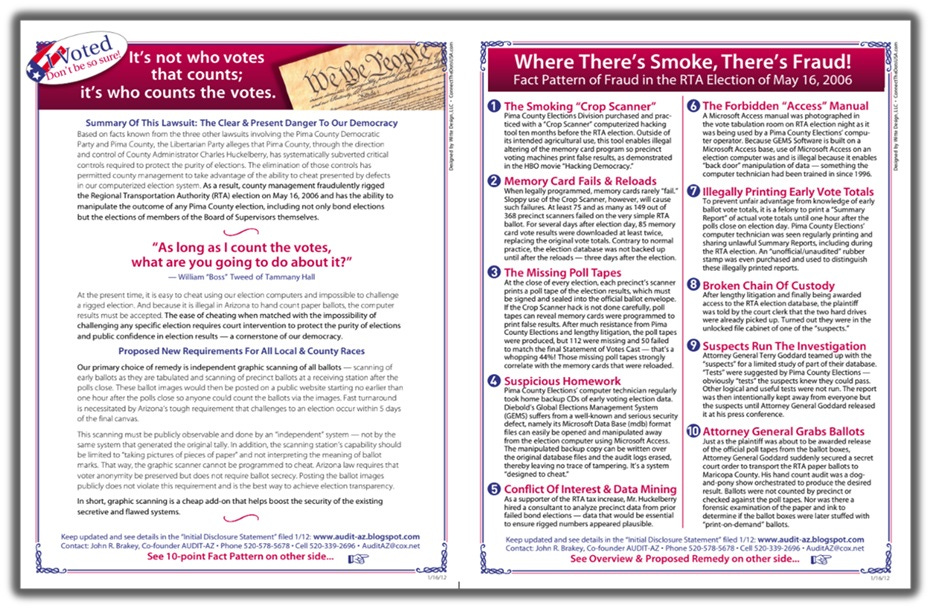
III. The Cropscanner Issue
Politically and rhetorically powerful point:
County admitted owning the device
Defense focused on destroying it
Risner argues capability remains
This is one of the most provocative factual disputes.
IV. Jurisdiction Already Decided
Legally significant:
Risner leans heavily on the Court of Appeals ruling that the trial court does have jurisdiction.
This is important framing for policymakers and courts.
V. The Constitutional Framing
Risner anchors the entire case in:
“purity of elections”
Arizona constitutional duties
That elevates the case beyond a typical election dispute.
“There are moments in life when curiosity turns into responsibility — when you realize you’ve crossed a line you can’t step back over. For me, that moment came during the long fight over the RTA election.” John Brakey
We thought we were making a routine public-records request. The county fought us like we were trying to steal the nuclear codes.
That level of resistance is often the first clue that something important is being protected.
This chapter explains what unfolded through four major legal cases — the four doors we had to force open — and what those cases taught us about secrecy, power, and the fragility of democracy when verification disappears.
6. Core Principle
A secret ballot protects voters.
Secret counting protects POWER.
When counting is opaque, trust becomes a substitute for verification.
And trust is not a system.
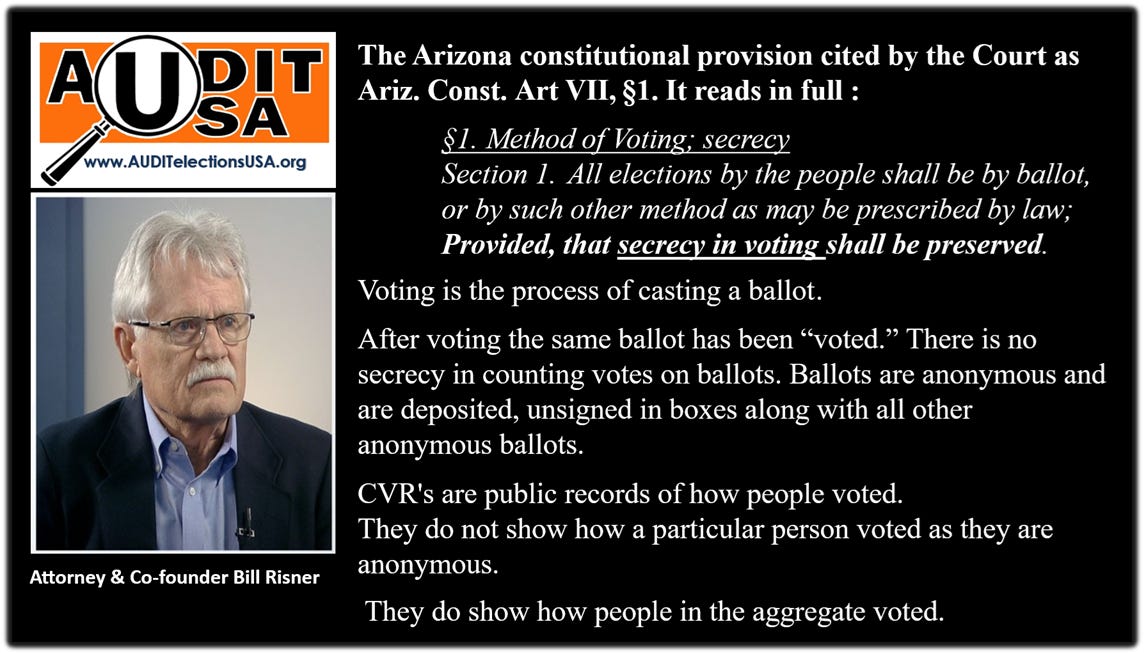
By 2014, after eight and a half years of litigation, the Pima County RTA case ended in frustration, having traveled through the Arizona court system approximately one and a half times.
The Value of Experienced, Ethical Leadership
by John R Brakey
AUDIT USA’s work has benefited from the involvement of experienced election officials who understand both the strengths and the limitations of modern election systems.
Among them is former Arizona Secretary of State Ken Bennett, whose decades of public service have consistently emphasized procedural integrity and evidence-based verification.
Colleagues across the political spectrum have often noted a defining characteristic of Bennett’s approach:
a commitment to follow the evidence wherever it leads.
That mindset is essential to the next generation of election confidence.
his effort is not about personalities.
It is about building systems that work — regardless of who is in office.
But experienced public servants who understand the machinery of elections play a critical role in helping jurisdictions modernize responsibly.
As counties like Cochise and potentially Pima explore additional transparency measures, the opportunity is clear:
Simple, lawful verification tools can significantly strengthen public confidence — if leaders are willing to implement them.
The path forward does not require reinventing elections from scratch.
In many cases, the data needed for meaningful public verification already exists.
The challenge — and the opportunity — is to use it wisely.
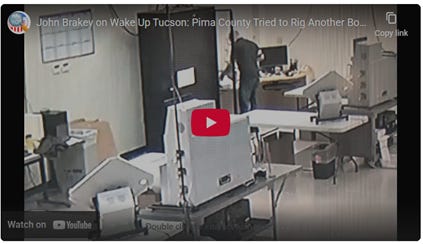
7. Spotlight: “Caught in the Act” — 2015 Bond Election (Wake Up Tucson segment)
John Brakey on Wake-Up Tucson: Pima County Tried to Rig Another Bond Election - Thursday, October 29, 2015.
This is what cheating with impunity looks like.
In 2015 Pima County Bond Election: How Citizen Oversight Exposed Critical Concerns and Hacking Attempt on video. Same video as above Play video 11 minutes
Ten years after the RTA debacle, an employee at the Pima County Elections Division broke into a sealed part of the central tabulator to hook up an ethernet connection.
Elections employee breaking the seal (he’s worked there 10 years).

This occurred after the Logic and Accuracy (L&A) Test was completed and a seal was placed prominently on the closed door of the system. This, of course, was hours after I (Brakey) had left the observation room. I drove to my home, spent a couple of hours writing and emailing a number of people about the L&A Test and, by habit, hit the hot link to the election department’s live feed. Moments later, I was watching the act take place before me.
2015 Another Pima County Bond Election Caught in the Act?
8. The following is Brakey’s letter to the Secretary of State
To Michele Reagan Arizona Secretary of State:
I am an experienced, well trained election observer for three political committees and at least one or more nonpartisan candidates on the Nov 3 ballot. (On bottom have listed groups)
On the morning of Tuesday, Oct 27, 2015, I observed the logic and accuracy test at Pima County Elections (PCE). After the testing was done (about 11am) I went to my home office to write a report of my observations and concerns in this election.
I turned on the live video feed and had it playing on my Samsung flat screen tv. For several hours as I was writing my report, I saw no activity at PCE. After I finished my report, I emailed at 2:56 pm. At about 3:00 pm, I noticed two men who earlier were part of the L & A test enter the room. At about 3:03 pm, I took the attached picture of an employee of ten years removing a security seal and connecting ethernet cables.
The second person turned on the computer. I could see that he went into a program I had observed earlier that day called ES&S “Election Reporting Manager” (ERM).
At this point I called some friends thinking that this could not be true. Maybe there were party observers out of camera range. After several more minutes passed, PCE Director Brad Nelson entered the room and sat on a chair right next to the man on the computer. Mr. Nelson had to have seen that the door to the computer cage was wide open (as seen in picture above).
No sound came through the video feed, but Brad appeared to say something and then started spinning around in the chair.
After a few more minutes of trying to figure out what to do, I decided to go and see for myself what was going on. I live about five minutes from Pima County Elections. When I got to the public observers’ door, it was locked.
I then noticed that Mr. Nelson was now with several other gentlemen on the Westside corner of PCE. I approached him and asked if I could talk to him. I then asked him if there was anything wrong with the live video feed.
He said no and explained to me quickly how it worked.
I then said, “take a look at this,“ and I showed him the photograph on my smartphone depicting an individual breaking the seal and unlawfully entering the computer cage that contains the Election Management System’s computers which were previously sealed. I also have a video recording of that incident.
Mr. Nelson acted surprised and said for me to wait for him at the public observers’ door while he figured out what’s going on.
After about 25 minutes, Mr. Nelson informed me that he called the party observers, identified a mistake, and scheduled the L & A test redo for 8:00 AM.
I knew that he was not being honest with me. Mr. Nelson had to have known when he entered the room that protocol was violated. One could not have missed this obvious breach under his supervision and in such close proximity.
I hope that the above information warrants a proper investigation. We are concerned and there are other serious issues that the Secretary of State’s office should investigate with us.
Additionally, I wanted to mention that I deeply appreciate your prompt work last week addressing the issue of verifying elections and hand count audits in Pima County.
Please help us make sure that elections are true and accurate .
Respectfully yours,
John R Brakey, of AUDIT-AZ & Special task force leader for Citizens Oversight for Verifiable Elections. Mission of Citizens Oversight for Verifiable Elections, COVE.
9. The Value of Experienced, Ethical Leadership and Ken Bennett Knows Elections
AUDIT USA’s work has benefited from the involvement of experienced election officials who understand both the strengths and the limitations of modern election systems.
Among them is former Arizona Secretary of State Ken Bennett, whose decades of public service have consistently emphasized procedural integrity and evidence-based verification.
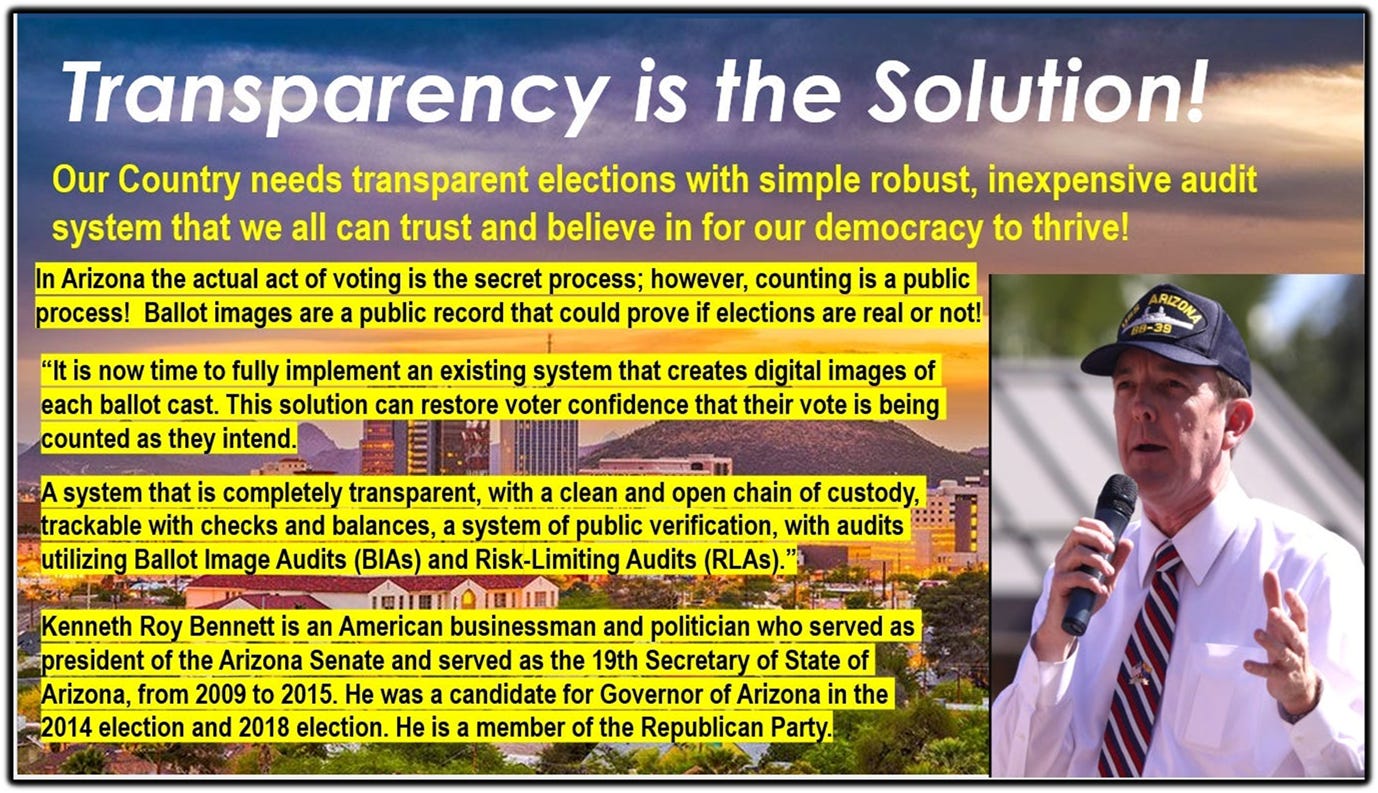
Colleagues across the political spectrum have often noted a defining characteristic of Bennett’s approach:
A commitment to follow the evidence wherever it leads.
That mindset is essential to the next generation of election confidence.
Ken effort is not about personalities.
It is about building systems that work — regardless of who is in office.
But experienced public servants who understand the machinery of elections play a critical role in helping jurisdictions modernize responsibly.
As counties like Cochise and potentially Pima explore additional transparency measures, the opportunity is clear:
Simple, lawful verification tools can significantly strengthen public confidence — if leaders are willing to implement them.
The path forward does not require reinventing elections from scratch.
In many cases, the data needed for meaningful public verification already exists.
The challenge — and the opportunity — is to use it wisely.
10. By Design
In 2006, former Representative Ted Downing and Senator Karen Johnson introduced SB 1557, a bill that would have mandated random audits and hand counts for all races, including county contests. However, Brad Nelson, then Pima County Elections Director, and Karen Osborne, Maricopa County Elections Director, lobbied against the inclusion of county races.
According to Downing, Nelson warned that including county races would be a “deal-breaker” and that both Nelson and Osborne would oppose the entire bill if it included them. Faced with this threat, the sponsors were forced to remove county contests from the legislation in order to ensure its passage.
As a result, SB 1557 was passed without audit requirements for county races, and it eventually became law under A.R.S. §16-602.
11. Testimony Confirms Intentional Exclusion of County Races and Bond Elections.
This exclusion was later confirmed in sworn court testimony by former Rep. Ted Downing, who clearly explained that political pressure from election officials led to the removal of county-level audits from the law.
▶️ Watch: Court Testimony from Ted Downing on the Exclusion of County Races
Pima and Maricopa County’s Influence on Election Law in 2006, Just before the RTA bond Election
This is not an isolated case. Years ago, Pima County had a history of not only resisting transparency in election and public records law, but also actively influencing the drafting of election statutes in ways that reduce public oversight on their own elections.
12. Why This Matters Now
A new bond election is approaching on March 10, valued at approximately $2.67 billion. Before voters’ head to the polls, it is worth revisiting the previous two bond elections to understand what happened—and why it is essential that this upcoming election be fully auditable and publicly verifiable.
This is not about relitigating the past for its own sake. It is about applying hard-earned lessons to present-day elections so that confidence is based on evidence, not assumption.
Fortunately, we already have a straightforward path forward.
In 2007, we won a court case requiring the release of the election database. That victory created something extremely important: the ability to independently check the computerized results using the system’s own underlying records.
When the Cast Vote Record (CVR) database is combined with the ballot images of the original ballots, the records can be sorted back into their individual precincts and subjected to meaningful risk-limiting audits (RLAs). This allows citizens—not just officials—to independently verify that the reported outcome matches the actual ballots.
That is the gold standard of modern election verification.
Here is a link demonstrating how easy it is to use ABE — Auditable Ballot Examination.
13. Why This Moment Is Different
What makes the upcoming bond election particularly important is not simply its size, but what we now know from experience.
Over the past two decades, litigation, depositions, and court-ordered disclosures have revealed how difficult it can be to reconstruct election truth after the fact—especially once statutory deadlines have passed and systems have been reset.
The lesson from the RTA experience is straightforward:
If meaningful verification is not built into the process before certification, it may be impossible to fully reconstruct later.
That is why the focus today must be forward-looking. The goal is not merely to trust election systems, but to ensure they can be independently checked using their own data.
14. A Real-World Reminder
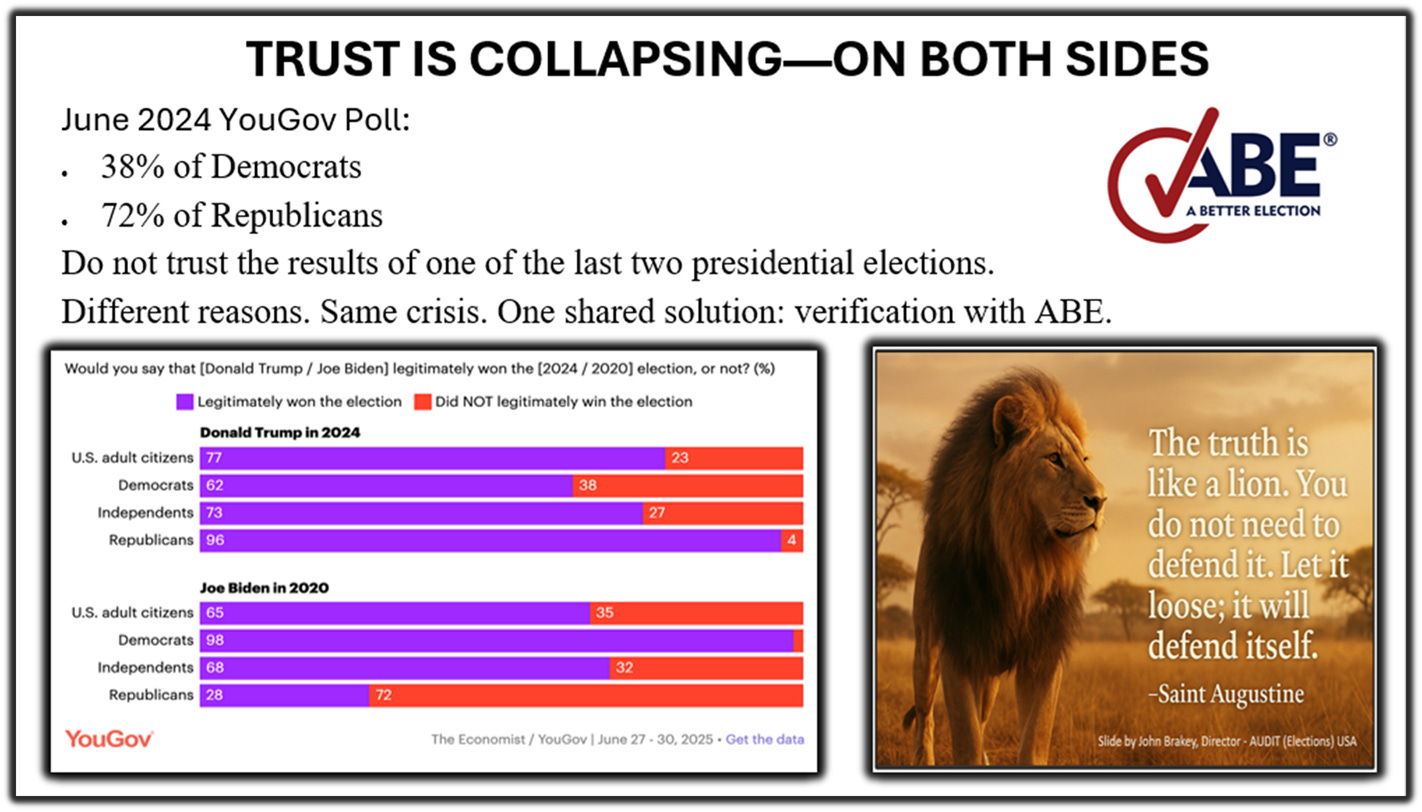
In June 2024, Maricopa County officials reported that a temporary election worker was arrested after removing a facility access key and fob associated with controlled areas of the Tabulation and Election Center. County officials stated there was no evidence that vote tabulation was affected and that security protocols were reinforced.
Incidents like this do not demonstrate that election outcomes were altered.
They do demonstrate something policymakers should clearly understand:
Complex, highly computerized systems must be designed to remain publicly verifiable even when access-control incidents occur.
Security events occur in every large technical system — banking, aviation, defense, and elections alike. The long-term answer is not to assume perfect human behavior.
The durable answer is architectural transparency.
15. The Ballot Image Debate — What Actually Matters
For years, one of the most common objections to releasing ballot images has been the concern that voters might write identifying information, profanity, or other markings on their ballots. That concern has often been used to justify heavy redaction or even wholesale withholding of ballot images.
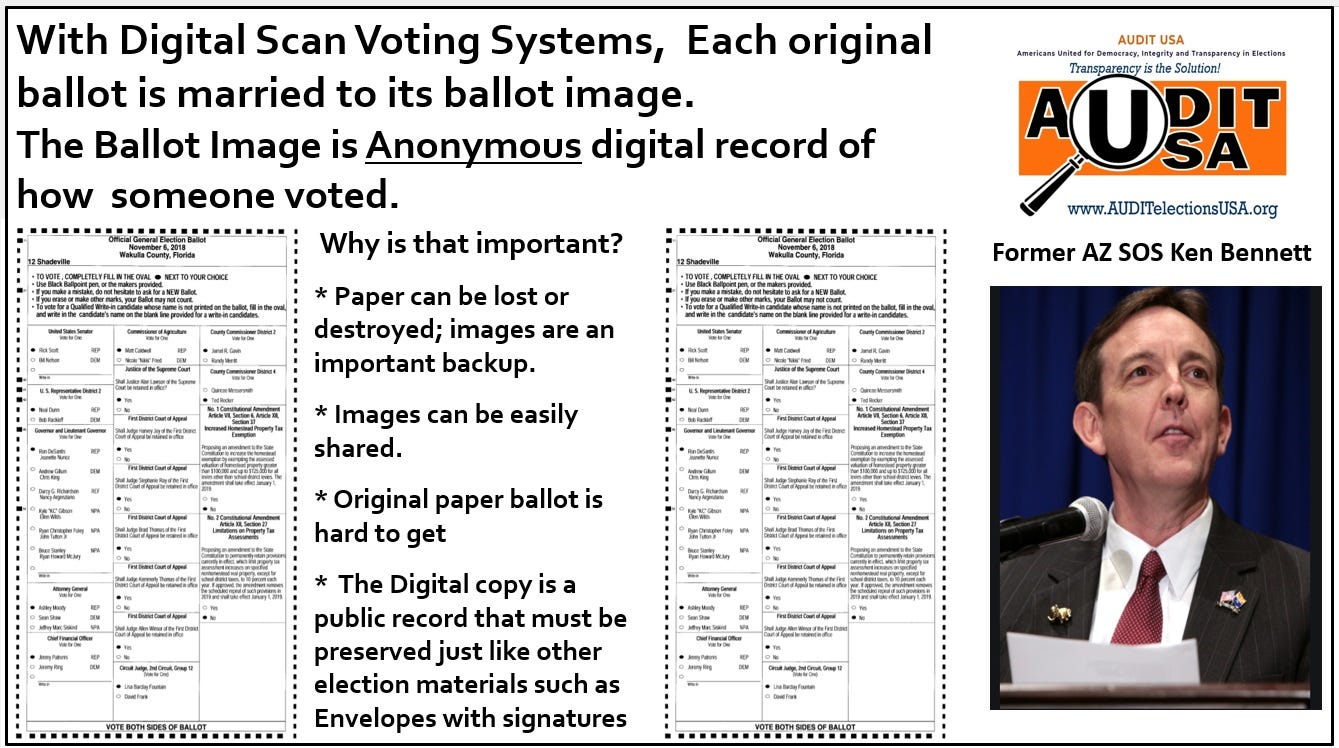
From an evidence perspective, however, excessive redaction creates its own risk.
Ballots are legal election records. When images are altered after the fact — even for well-intentioned privacy reasons — public confidence can be unintentionally undermined. Observers may reasonably ask whether the record they are seeing is complete and unmodified.
Modern election transparency frameworks therefore focus on a simpler principle:
protect voter identity through proper ballot handling and separation
preserve the evidentiary integrity of the ballot image
enable independent verification without altering the underlying record
When implemented correctly, ballot images and Cast Vote Records (CVRs) allow the public to evaluate tabulation behavior and voter-intent questions without compromising ballot secrecy.
In the digital era, visibility is not the enemy of confidence.
Opacity is The lack of transparency — when critical processes cannot be easily seen, understood, or independently verified.
16. What Transparency Used to Look Like
Historically, election transparency was physical and directly observable.
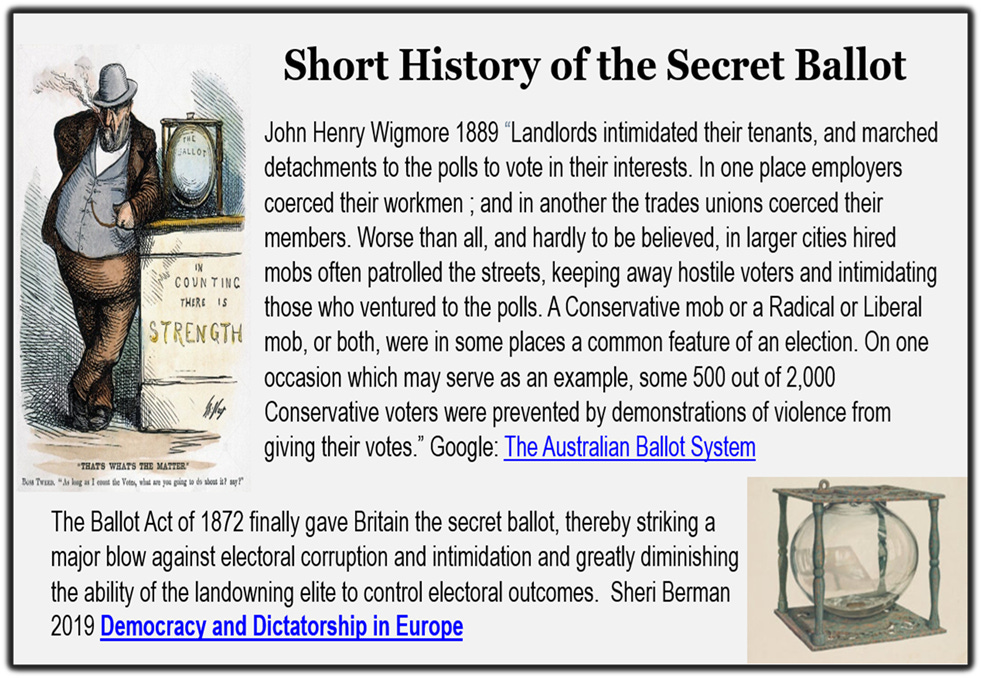
In earlier eras, ballots were counted in public view. Observers could watch the tally, see the marks on ballots, and follow the chain of custody with their own eyes. The process was slower, but it was visible and understandable to the public.
Today’s vote-by-mail and high-speed tabulation environment is fundamentally different. The scale is larger. The speed is faster.
The evidence trail is increasingly both digital and with hand marked paper ballots.
But the public expectation has not changed.
Voters still expect that election outcomes can be independently checked — and they are right to expect that.
To understand ABE and modern election transparency, we must first understand where ballot secrecy came from.
How America Got the Secret Ballot
To understand ABE and modern transparency, we must understand where secrecy came from.
Secrecy and privacy are not the same thing.
People confuse them today — but historically, the distinction mattered.
Before the Secret Ballot, voting was a public act:
🎥 Watch: How America Got the Secret Ballot - 6 minutes
James Madison experienced this firsthand. After losing a corrupted election, he wrote in 1785:
“The only radical cure for those arts of electioneering which poison the very fountain of liberty is the secret ballot.”
Historian John Henry Wigmore described the era bluntly:
“Landlords intimidated tenants. Employers coerced workers. Armed mobs patrolled the streets.”
Voting could be dangerous.
Democracy had become fear-based.
The Australian Ballot Revolution
Reformers turned to a breakthrough from across the world:
anonymous, government-printed ballots
marked in private
counted in public
This system swept across America and transformed elections.
But the reform had an unintended side effect:
government gained control of the counting process.
In the 21st century, secrecy crept from the voting booth into the counting room. And that brings us to why ABE exists.
The Arizona hand-count audit A.R.S. 16-602 serves as a case study of these challenges, demonstrating a process that is both flawed and statistically invalid.
Secrecy and privacy are not the same thing.
Today the terms are often used interchangeably, but historically the distinction was critical.
Before adoption of the secret ballot in the late nineteenth century, voting in the United States was largely a public act:
votes were often cast aloud
party-colored ballots were deposited openly
newspapers frequently printed ballots
political operatives monitored polling places
voter intimidation was widespread
This system created fertile ground for:
employer coercion
landlord pressure
political retaliation
and, in some jurisdictions, armed intimidation at polling sites
In many places, voting could be socially or economically dangerous.
17. The Structural Problem
Over the past two decades, election administration has changed dramatically:
Most ballots are now cast by mail or vote center
Ballots are processed in mixed batches (often ~200 ballots)
Tabulation is fully computerized
Precinct-era assumptions no longer hold
Yet Arizona’s hand-count audit law (A.R.S. §16-602) still reflects an earlier election model.
Result:
The appearance of oversight remains
But the statistical power and deterrent value of the audit have declined
It is important to be clear:
This is not evidence of fraud.
This is evidence of an obsolete audit framework.
That distinction is critical for serious policymakers.
18. What Courts Have Made Clear
Two decades of election litigation have established a consistent reality:
Courts do not intervene based on suspicion alone.
They require:
preserved records
testable evidence
repeatable analysis
This has been the missing bridge in many election disputes.
Without an evidentiary record that can be independently examined, courts are understandably reluctant to act — even when concerns are sincerely raised.
19. Why Ballot Images and CVRs Matter
Modern voting systems already generate:
ballot images
Cast Vote Records (CVRs)
batch tracking data
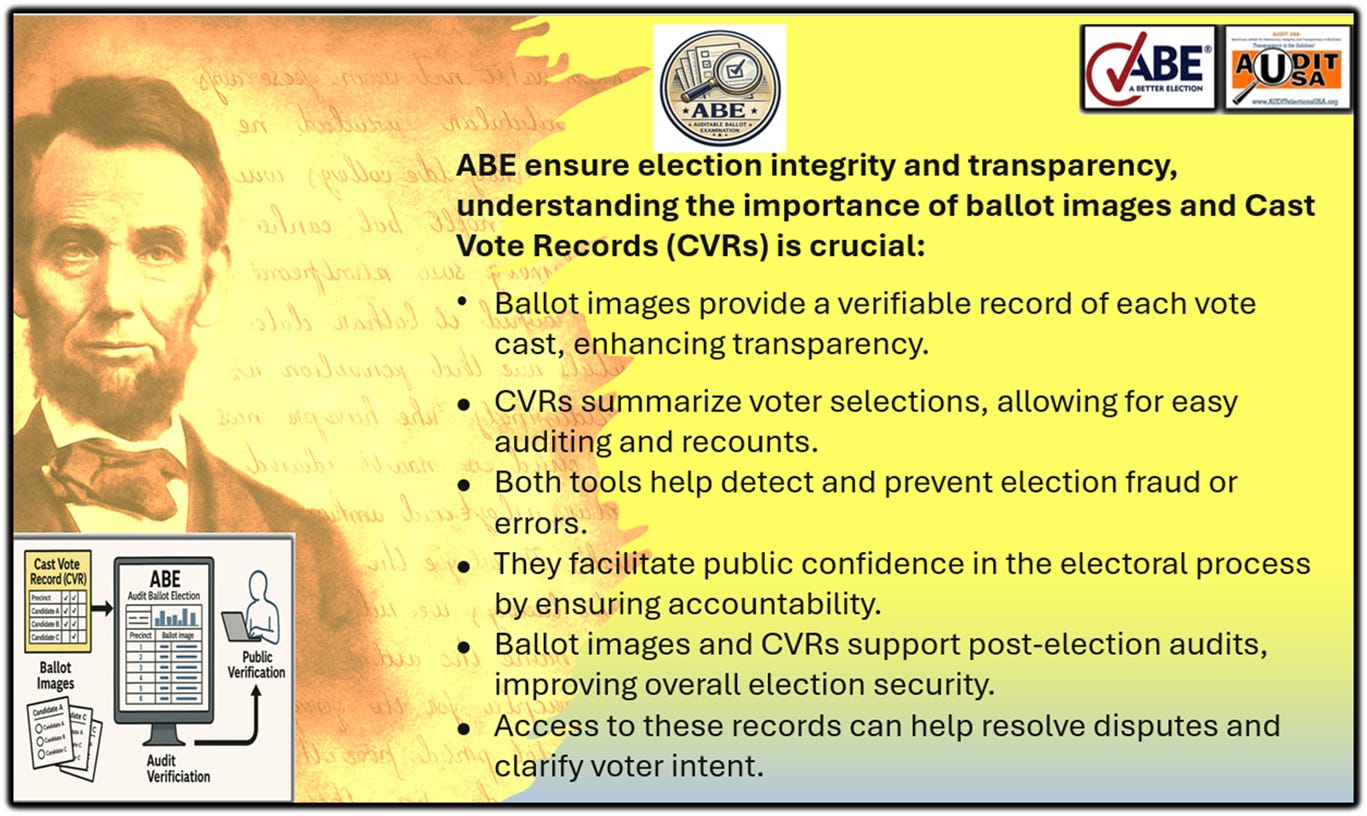
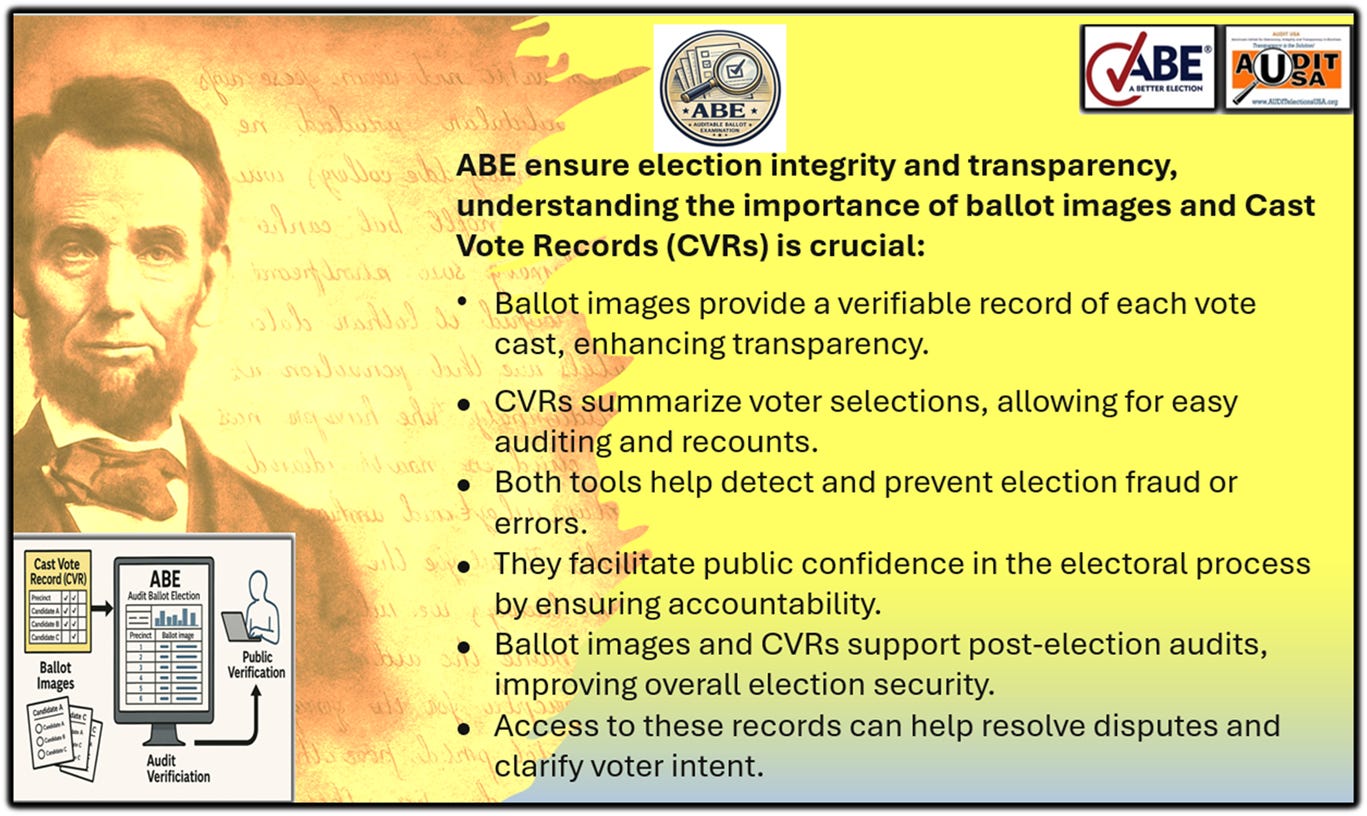
When voter identity is properly separated — as it is in the overwhelming majority of ballots — these records enable:
independent verification
repeatable analysis
precinct-level reconstruction
scalable oversight
Properly used, ABE provides something election officials are often forced to trade off:
speed and accuracy at the same time.
This is how confidence is built in modern digital election systems.
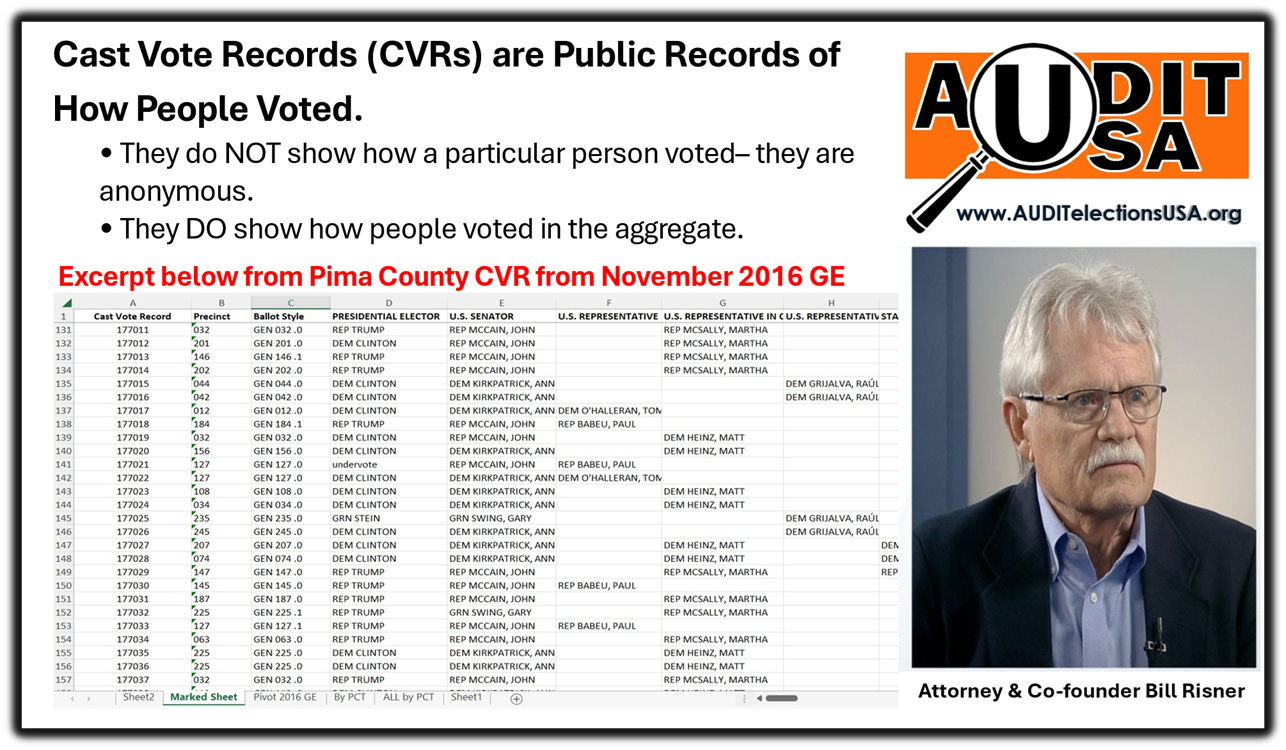
Link to the Pima County 2016 General Election Cast Vote Record (CVR) Database
20. Why ABE Fits This Moment
The Auditable Ballot Examination (ABE) framework was designed specifically for this modern environment.
ABE is built to:
preserve ballot secrecy
enable independent verification
operate in vote-by-mail systems
scale to large counties
produce evidence courts can evaluate
In short:
ABE shifts election oversight from trust-based to evidence-based.
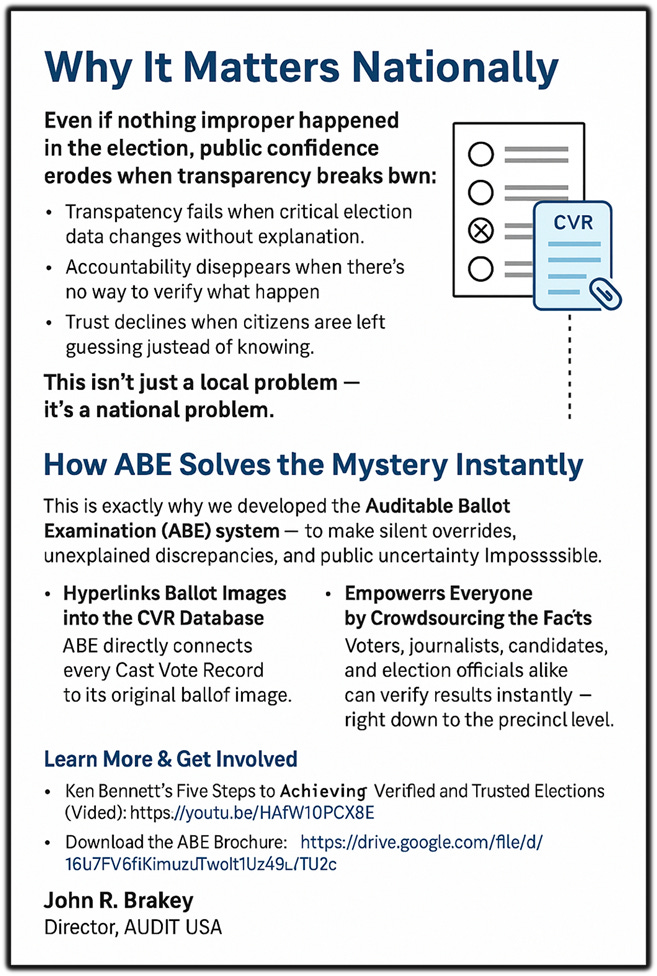
21. The Trust Problem — and the Solution
For years, the public has largely been asked to accept election outcomes based primarily on institutional assurance.
In the digital era, that model is under strain.
As President Reagan famously said:
“Trust, but verify.” Transparency is not an accusation.
Transparency is a stabilizer.
It allows:
officials to demonstrate accuracy
observers to confirm it
courts to evaluate disputes
the public to regain confidence
“Trust is earned through verification, not assumed.” Ken Bennett
22. Bottom Line for Policymakers
Arizona does not face a proven tabulation crisis.
Arizona faces a confidence architecture problem.
If elections are to remain credible in the digital era, systems must be:
transparent
trackable
publicly verifiable
Because in modern democracies:
Procedure builds confidence only when the public can see the proof.
23. A Practical Audit That Could Be Done Today
Given the documented history of the past two bond elections, a simple but powerful audit could be conducted during the official canvass period.
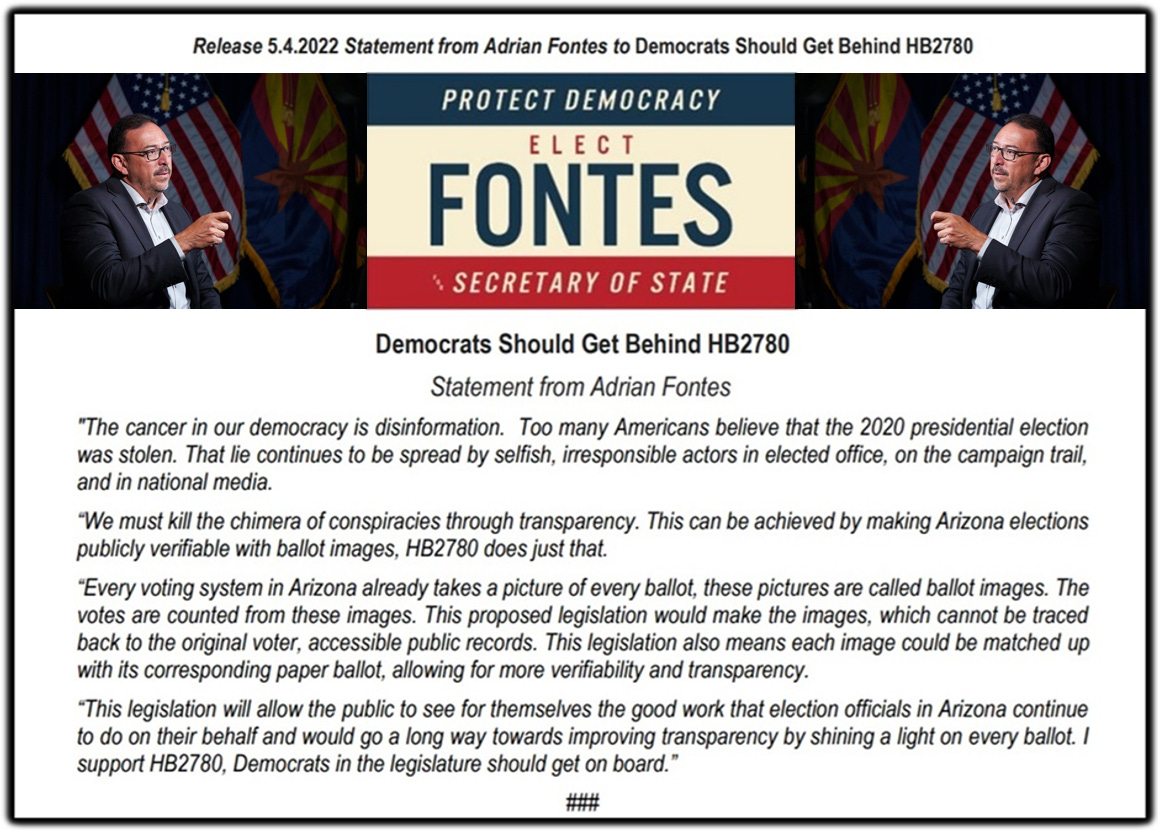
As Arizona Secretary of State Adrian Fontes has noted, counties have the capability to use ballot images and cast vote records (CVRs) in conjunction to verify the accuracy and internal consistency of reported results. Currently, this process is only permitted during the canvass procedure first approved by the Board of Supervisors. The necessary data is already available; however, what is often lacking is an established, standardized protocol that allows for transparent public observation and understanding.
The audit process itself is straightforward and fast.
For example, auditors could randomly select a dozen precincts and review them using two people and two screens:
Person One reads the voter selections from the ballot image.
Person Two verifies that those selections match the corresponding entries in the CVR database.
With only two contests on the ballot, this review would be extremely fast and highly informative.
Importantly, the precincts to be audited should not be selected until after the election results are publicly committed. That sequencing protects the integrity of the audit by preventing any possibility of advance targeting.
Because of our 2007 court victory, the database must be made available to the political parties. As for ballot images, we can demonstrate that more than 99.83% of ballots are fully anonymous. The remaining edge cases—such as certain ballot styles or provisional ballots—are manageable and correctable with well-established procedures.
“Using the 2020 election in Maricopa County, Arizona, as a case study, we find that releasing individual ballot records would reveal no vote choice for 99.83% of voters.” — Kuriwaki, Lewis & Morse, Science Advances
Notably, the RTA bond election itself presents minimal ballot-style complexity because most voters receive essentially the same ballot. That makes this type of audit particularly efficient and well suited for public demonstration.
Given the documented history of the previous two bond elections (explained below), the public deserves elections that are transparent, trackable, and publicly verifiable. Using ABE, that standard is not theoretical—it can be implemented efficiently during the canvass with tools counties already possess.
24. The Election That Changed Everything (2006 RTA)
The 2006 Regional Transportation Authority (RTA) bond election in Pima County was not supposed to change my life. It was a local bond measure—important, yes—but nothing that hinted at an eight-and-a-half-year legal war.
At the time, I believed in the system.
I believed elections were run competently.
I believed courts corrected mistakes.
What I did not yet understand was how fragile all of that becomes when transparency disappears.
We were not looking for fraud. We were not trying to overturn an election. We were simply requesting public records—records that belonged to the public by law.
In fact, I voted for the RTA.
The county’s reaction told us everything.
Instead of producing records, they resisted.
Instead of explaining procedures, they stonewalled.
Instead of welcoming verification, they treated us as a threat
25. When the Courts Became Part of the Story
The manipulation did not stop with elections.
The Pima County judge who dismissed our cases later became Presiding Judges—the highest positions in the county judiciary.
An appellate judge filed an amicus brief not to aid justice, but to create a conflict of interest that forced our case out of Division Two.
It worked.
We were reassigned to a courtroom where the chief judge’s chief of staff had been the right-hand man to the Attorney General defending the county.
This was no longer simply litigation.
It had become a political chessboard.
After eight and a half years, we had exposed what we needed to expose.
We stopped appealing—not because we were wrong, but because the system had revealed itself.
26. What the Four Cases Taught Us
These cases taught us lessons that still guide this work:
Elections without transparency become trust exercises
When oversight disappears, courts often follow power, not truth
This is not history for history’s sake.
Democracy does not ask the public for blind trust.
It earns trust through systems that citizens can verify.
It is a warning.
President Reagan often said, “Trust but Verify.”
Ken and I would add: “Without Verification, Trust cannot be Established.”
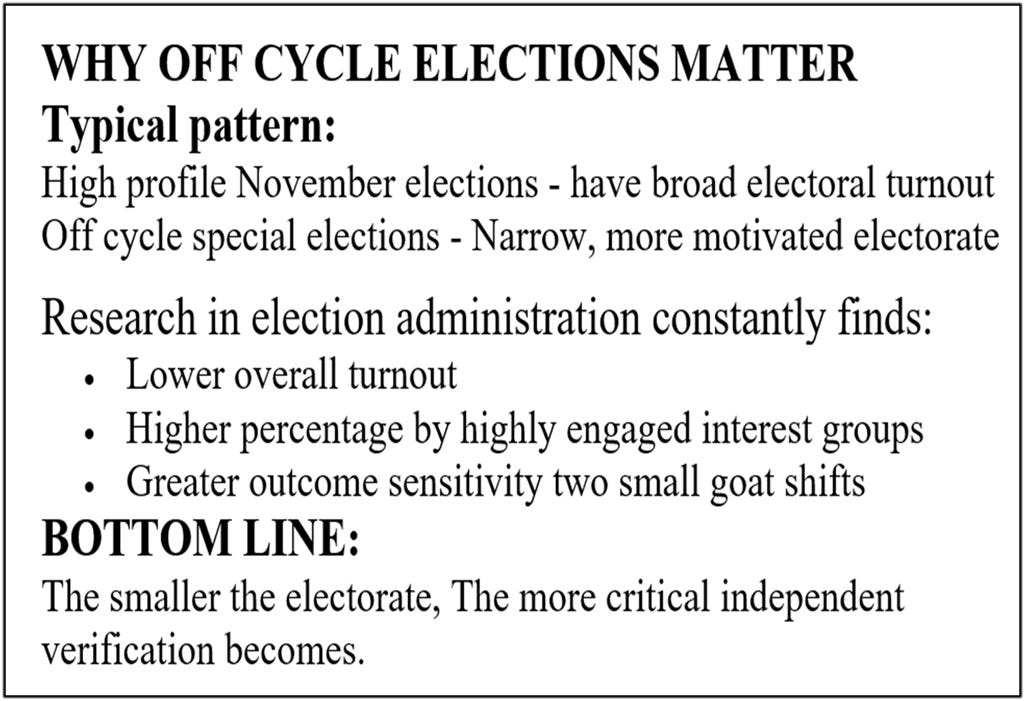
WHY OFF CYCLE ELECTIONS MATTER
Typical pattern:
High profile November elections - have broad electoral turnout Off cycle special elections - Narrow, more motivated electorate Research in election administration constantly finds:
Lower overall turnout
Higher percentage by highly engaged interest groups
Greater outcome sensitivity two small goat shifts
BOTTOM LINE:
The smaller the electorate, The more critical independent verification becomes.
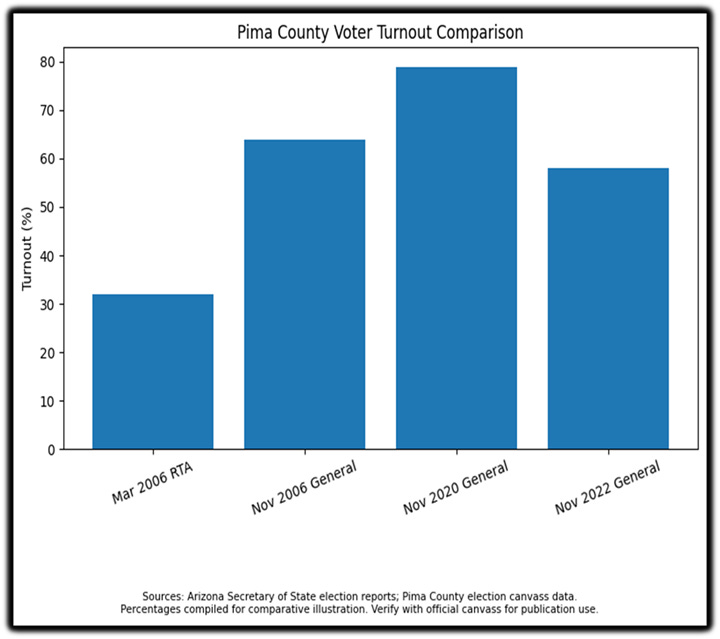
March elections tend to fly under the radar. When turnout drops, the electorate becomes smaller and more concentrated — meaning the side that is most organized and motivated can have outsized impact relative to a high-turnout November election.
27. Contact Information
John R. Brakey
Executive Director, AUDIT Elections USA
Co-Developer of the ABE Hybrid Verification System
Election Transparency Investigator, Educator & Reform Advocate 520-339-2696
JohnBrakey@gmail.com Link to this story on John Brakey Substack
Resources:
ABE Brochure: https://bit.ly/3Svn7n4
ABE User Manual: https://bit.ly/3yZrKPi
Link to “They Sued Us for Asking”: https://johnrbrakey.substack.com/p/they-sued-us-for-asking-inside-santa
AUDIT USA Launches Free Election Verification Tool ‘ABE’ — By Jonathan Simon (This tool promotes election integrity by providing evidence-based transparency, potentially curbing misinformation related to election fraud.
How a “Small” Decision in Miami-Dade Could Transform Election Transparency Nationwide - Why a Quiet Legal Victory in Florida Could Help Restore Trust in American Elections Rev. 1/28/26
Open Letter to Supervisors Davis and Fanning — A Public Message to the
Citizens of Santa Cruz County, Arizona Subtitle: Transparency and accountability form the cornerstone of public trust. These principles are more important than ever. Rev 1/28/26
AUDIT USA Launches Free Election Verification Tool ‘ABE’ — Jonathan Simon
Part 3 of 3: Voter Data, Centralized Power, and the Future of Our Democratic Republic - Subtitle: How Citizens Can Regain Power: The Importance of Transparency, Verification, and Courage—Why Election Legitimacy Requires More Than Blind Trust Dec 29, 2025 By Ken Bennett & John Brakey
Chapter 4 —A Special Report: The Golden Rule of Democracy: Voting is Secret, Auditing must be Publicly Verifiable by Precinct with digital ballot. The Hidden History of Election Chicanery ABE: Hybrid System for Transparent, Trackable, Publicly Verified Elections. ABE (Auditable Ballot Examination)
Former Arizona Secretary of State Ken Bennett: Five Steps to Achieving Verified & Trusted Elections: Democracy Relies on Trust and Verification. Jul 31, 2025
AUDIT Elections USA
INFORMATION SHEET ON OUR CURRENT EFFORTS TO STRENGTHENING OUR DEMOCRATIC REPUBLIC THROUGH A HEALTHY DEMOCRACY
The United States is both a constitutional Democratic Republic and a representative democracy. The smartest messaging acknowledges that reality instead of picking a side.
The United States is both a constitutional democratic republic and a representative democracy. Effective election policy should recognize and strengthen both traditions rather than frame them in opposition.
For more than two decades, AUDIT USA (auditelectionsusa.org) has worked to protect something simple but essential: the public’s ability to see, verify, and trust our election records.
We remain on the front lines in the fight for meaningful election audits that can actually verify election results. The work we do is not flashy, but it is consistent and important:
1. We recently achieved a hard-fought victory in Florida, where our 8-year lawsuit was recently resolved with the Supervisor of Elections in Miami-Dade County, the 7th largest elections jurisdiction in the United States. Miami-Dade County has agreed to save ballot images for all future elections. Until now, Miami-Dade County has deleted ballot images, destroying this vital audit record. The attorneys who have stood by this important case issued a Press Release (link) in which they specifically recognized AUDIT USA, who was the initiator of this lawsuit and an ongoing partner behind the scenes. John Brakey, AUDIT USA Executive Director, and Susan Pynchon, Research Director, have met with this dedicated team of attorneys by Zoom almost every Saturday for 8 years.
While other counties, such as Volusia County, have been saving ballot images for years, the remaining 7 largest counties in the state are still destroying them, so we have more work to do! We will now be educating the 7 remaining largest counties in Florida to convince them to join Miami-Dade in saving ballot images. If they don’t agree, our team of attorneys is prepared for further litigation. We will eventually win those cases because federal law, state law, and good election practices require saving these important election records. We need funds to support this effort and pay our attorneys.
2. We have developed a ballot-image audit system, which we have named ABE after Abraham Lincoln, who believed in the public’s right to the truth. ABE stands for Auditable Ballot Examination. It is a software program that allows election officials, candidates, researchers, journalists, and voters to verify election results. We are offering this system at no cost because it is in keeping with our mission of transparent, trackable, and verifiable elections. We believe that ABE will revolutionize election verification as it becomes better known and better understood. We need funds to travel to election offices to demonstrate this revolutionary audit program.
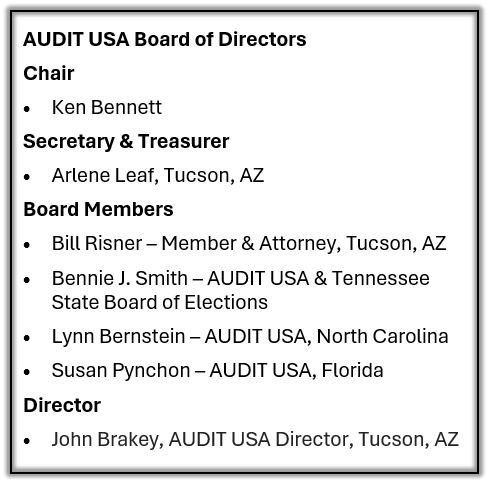
3. Ken Bennett, former Arizona Secretary of State and former President of the Arizona Senate, has joined our board as Board Chairperson. He and our Executive Director, John Brakey, have formed a true nonpartisan alliance, sharing their passion for transparent, trackable, and verifiable elections. Ken and John are preparing to meet with Secretaries of State and election officials around the country to explain the importance of ballot images as an audit record and also to demonstrate ABE to them. Some of their meetings will be by Zoom and others will be in person. We need funds to commence Ken and John’s outreach program.
4. We had an important victory at the Arizona Court of Appeals in the lawsuit Santa Cruz County vs. AUDIT USA and John Brakey. Three years ago, John Brakey requested election records from Santa Cruz County, including the Cast Vote Record – records the county had freely provided in the past. Santa Cruz County promised to provide the requested records and then, on the same date they had promised to provide them, they sued AUDIT USA and John Brakey, asking the court for a declaratory judgment as to whether the Cast Vote Record is a public record or not. This unjustified and unwanted lawsuit has drained our energy and our resources for 3 years. The county initially lost in Superior Court, where the judge told them their lawsuit was “outside the bounds of public records law.” However, the county’s high-paid private law firm found ways to appeal 3 more times to the Arizona Court of Appeals. They lost all 3 times but now are trying to avoid reimbursing us for the legal fees incurred by our attorneys.
5. We are involved in court cases and many issues around the U.S. With our collective knowledge about elections, developed over two decades of work studying election processes and observing actual elections, we often act as mentors, advisors, and advocates for election integrity activists around the country. Our small staff often works 7 days a week. We need funds to continue paying them a modest salary.
6. Our website is full of important information and hundreds of important archived articles and videos, but many of those are hard to access. We need funds to pay for someone to help us bring our website up to date.
We’re a nonpartisan, nonprofit 501(c)(3) organization. Founded in 2005 as AUDIT AZ. We have focused on transparency and accountability in elections—especially the preservation and public release of ballot images. Around the country, we’ve shown up when it matters: pushing back against needless secrecy, advocating for record retention, litigating to prevent the destruction of vital election records, and making the case that transparent, auditable elections strengthen confidence for everyone, regardless of party.
Legal filings, public-records requests, technical research, and rapid-response advocacy require real resources. And right now, we’re at a point where additional support will directly determine how much we can do in the months ahead: how many fights we can take on, how quickly we can respond, and how effectively we can keep ballot images and other election records from being lost, deleted, or withheld.
The public should be able to verify election outcomes. We are at a tipping point on so many issues and your support will allow us to continue our important work.
Donate: AuditElectionsUSA.org/donate
AUDIT USA is a 501(c)(3) nonprofit; donations are tax-deductible as allowed by law.
Send donation check to:
AUDIT USA P.O. Box 26361
Tucson, AZ 85726
Or donate online:
www.AUDITElectionsUSA.org/donate/
We appreciate donations of any size.